Changes on horizon for regulating Hawaiian Electric

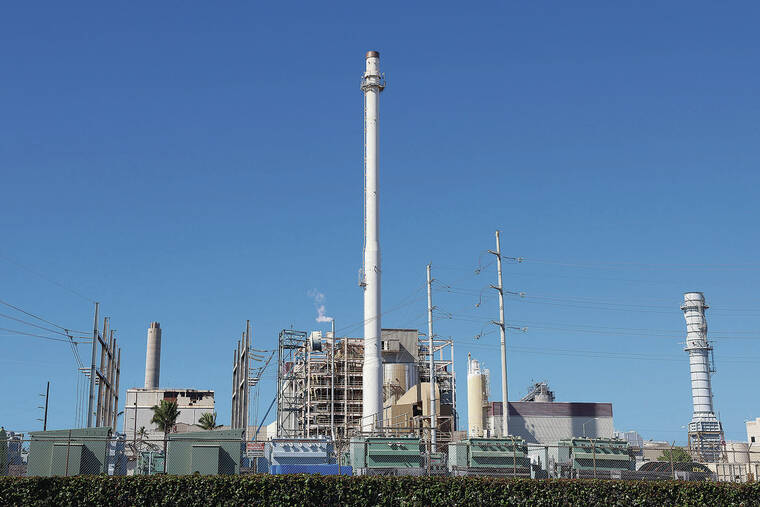
A state commission expects to modify the way it regulates Hawaii’s largest electric utility next year via a public proceeding likely to affect customer rates.
The state Public Utilities Commission already has begun gathering input from a working group of key stakeholders over how an existing regulatory framework based on performance might be modified, and an application from Hawaiian Electric is expected by the end of this year to begin a quasi-judicial proceeding to adjust a basis for rates under an updated framework starting in 2027.
A panel of state senators received a briefing on the process Tuesday, and much concern was expressed over whether customer bills will rise as a result.
The answer to this question from a Hawaiian Electric executive, PUC representatives and the state consumer advocate was: not necessarily.
Much of the concern over potentially higher rates has to do with hefty investments being made and planned by Hawaiian Electric to mitigate wildfire risks in the wake of the Aug. 8, 2023, fire that killed 102 people and destroyed most of Lahaina.
Sen. Chris Lee (D, Kailua-Waimanalo-Hawaii Kai) said he recognizes that the utility, which serves Oahu, Maui County and Hawaii island, needs to invest in things that include wildfire mitigation and grid reliability as well as renewable energy that displaces higher-priced fossil fuel power plants.
Don't miss out on what's happening!
Stay in touch with breaking news, as it happens, conveniently in your email inbox. It's FREE!
“There’s a lot on the table right now,” he said. “I’m worried … that we are potentially setting ourselves up for what could be one of the biggest cost increases to consumers really in history.”
Lee also expressed concern that PUC staff will be overmatched and steamrolled by representatives of the investor-owned utility seeking changes that benefit the company over customers.
PUC officials stood up for the existing regulatory framework that they said has protections for consumers and is being considered for changes that benefit ratepayers and the utility in balance.
This “performance-based regulation,” or PBR framework, was crafted in 2020 by the PUC at the direction of the Legislature under a 2018 law called the Ratepayer Protection Act. The new framework replaced a historical cost-of-service model in which Hawaiian Electric used to earn profits tied to capital improvement spending and typically would seek annual rate changes.
Adopting the PBR model also followed a change in 2010 to “decouple” electricity sales from utility profits.
Elements of PBR include sharing profits with ratepayers if profits are high enough, though this measure has not been triggered before.
Another piece of the new system — a portfolio of “performance incentive mechanisms,” or PIMs, — was added in 2021 and is designed to reward or penalize Hawaiian Electric financially in certain instances, including rewards for quicker additions of less expensive renewable energy and penalties for service interruptions.
The PUC initially estimated that the PBR framework and PIMs would yield an average monthly bill decrease of $1.27 for typical residential customers, adding up to about $12.6 million in 2021 and $69.9 million through 2025.
The PUC did not report actual bill impacts to the Senate panel on Tuesday, but noted that the package of incentives has not worked out as anticipated even with subsequent modifications.
More changes to the framework and incentives are expected to come out of the PUC’s planned proceeding next year and become effective at the beginning of 2027.
Ulupono Initiative, a socially minded investment firm that supports renewable energy expansion, told the Senate panel led by Sen. Jarrett Keohokalole (D, Kaneohe-Kailua) that the biggest reward tied to PIMs achieved by Hawaiian Electric was $3.7 million in 2021.
Michael Colon, Ulupono energy sector director, recommended that rewards be boosted for more renewable energy additions.
“It would bring down costs, we believe, because renewable energy is cheaper than oil,” he told the panel. “That savings (for ratepayers) would vastly outshine and outweigh the amount of performance incentives that the utility would get.”
Sen. Glenn Wakai (D, Kalihi-Salt Lake-Pearl Harbor) suggested that Hawaiian Electric wasn’t deserving of any rewards given some major reliability issues in recent years and high rates.
Mark Kaetsu, the PUC’s supervising attorney who oversees work on the PBR framework, said most electric utility regulatory bodies across the country still use a cost-of-service model, and that Hawaii’s PBR model has more tools than any comparable framework.
Keohokalole, who led Tuesday’s briefing as chair of the Senate Commerce and Consumer Protection Committee, said a good balance of rewards and penalties don’t appear to exist.
“With the PIMs, it seems like we’re talking about carrots here,” he said. “And to Sen. Wakai’s point, we’re not talking about sticks at all.”
Keohokalole asked Jim Kelly, Hawaiian Electric vice president of government and community relations, if it would be fair to assume that the utility will seek a higher rate basis for 2027 through 2031.
“No,” Kelly responded. “Because we don’t know what the numbers are yet.”
Kelly noted that a new Oahu fuel supply contract with Par Hawaii just approved by the PUC will reduce rates for many customers.
The amended contract was announced Monday, and should save a typical residential customer on Oahu using 500 kilowatt-hours of electricity $2.77 a month.
Michael Angelo, director of the Division of Consumer Advocacy at the state Department of Commerce and Consumer Affairs, said his office will be involved in the PUC process to update Hawaiian Electric’s regulatory framework as an advocate for ratepayers that scrutinizes costs and reliability.
Angelo noted that 56% of Hawaiian Electric costs in 2023 were related to fuel oil expenses, and that replacing fossil fuel power plants with renewable energy production remains a big opportunity to reduce rates.
The state has a goal to have 100% of electricity derived from renewable sources by 2045.
In 2024, the utility increased its share of renewable energy to 36% from 33% in 2023 and closer to a state milestone goal of 40% by 2030.