Hawaii residents and visitors evacuate ahead of a tsunami that brought some flooding


REUTERS/MARCO GARCIA
Honolulu resident Adam Jung loaded water and other supplies into his vehicle Tuesday after authorities warned residents of the possibility of destructive tsunami waves, following an earthquake which earlier struck off Russia’s Far Eastern Kamchatka Peninsula.

GEORGE F. LEE / GLEE@STARADVERTISER.COM
Malik Blu of Maui and Jules Davis of New York sat on a nearly empty Hilton Lagoon and Waikiki Beach during Tuesday’s tsunami warning.

GEORGE F. LEE / GLEE@STARADVERTISER.COM
Hilton Hawaiian Village personnel installed a Tiger Dam on Tuesday as a measure of protection against a possible tsunami.
Over a million Hawaii residents and visitors spent more than seven hours under threat of a potentially highly destructive tsunami Tuesday that triggered evacuations from low-lying coastal areas statewide.
The all-clear had not been declared by 10 p.m. but was expected following a tsunami warning issued by the National Weather Service around 2:45 p.m. in response to an 8.8-magnitude earthquake off Russia.
The temblor struck at 1:25 p.m. Hawaii time, 82.8 miles southeast of Petropavlovsk-Kamchatsky, Kamchatka, Russia, at a depth of 46 miles, according to the U.S. Geological Survey.
The warning resulted in Hawaii National Guard troops being activated, emergency alert sirens wailing several times, closing of the Hilo airport, flights canceled in and out of Maui, a U.S. Coast Guard order for all vessels to leave harbors and thousands of people in inundation zones relocating to higher ground and emergency shelters around the state. Emergency roads including Kolekole Pass on Oahu were opened to accommodate traffic, which did back up in several areas.
Gov. Josh Green urged the public to remain calm and safe as he provided several updates to the news media throughout the evening.
“You must stay off the beaches and away from harbors, rivers and low-lying areas,” Green said. “If you stay on beaches you could risk death.”
Don't miss out on what's happening!
Stay in touch with breaking news, as it happens, conveniently in your email inbox. It's FREE!
Waves from the expected tsunami were expected on all shores statewide, with a projected first arrival time on Kauai by about 7:10 p.m. followed by Oahu several minutes after that.
Green said at about 6:20 p.m. that wave measurements taken off Midway Atoll showed a 3-foot surge, and warned that waves anticipated for Hawaii could be the same size and resembling a wall of water with force able to move cars, trees, power poles and other large objects.
However, at about 8:30 p.m. there was no known damage to report.
By 9:25 p.m. the Pacific Tsunami Warning Center reported waves of 5.7 feet at Kahului, 4.9 feet at Hilo, 3.9 feet at Hanalei, 2.3 feet at Makapuu, 1.2 feet at Waianae and 1.1 feet in Honolulu. Other Hawaii areas listed were about 1 foot or less.
Charles “Chip” McCreery, director of the Pacific Tsunami Warning Center, said the first tsunami wave that hit Hanalei about 7:10 p.m. measured about 1.5 feet above normal sea level.
The biggest known effect more than an hour later, Green reported, was seawater at Haleiwa Harbor on Oahu receding enough to leave some boats grounded, and the largest ocean buoy reading off Haleiwa measuring a more than 10-foot swell.
Still, Green and emergency management officials said another two or three hours would need to pass and show diminishing tsunami wave cycle readings before the warning would be lifted.
“There have been significant changes in the ocean levels, especially on the North Shore of Oahu,” Honolulu City and County officials said in a news release around the same time. “Pacific Tsunami Warning Center experts remind everyone that the threat is not over and tsunami impacts could still occur over the next couple hours. … All residents in the City and County of Honolulu are urged to remain in higher elevations out of the tsunami inundation zone.”
The evacuation orders largely resulted in a safe retreat guided by emergency responders and government leaders, though there were traffic difficulties.
Mayor Rick Blangiardi, working from the city’s Emergency Operations Center, said, “This is a moment in time when people need to prioritize the safety of their families. We need everyone to take this situation seriously, act accordingly, evacuate inundation zones, and listen to first responders. We are asking everyone to remain calm and be safe.”
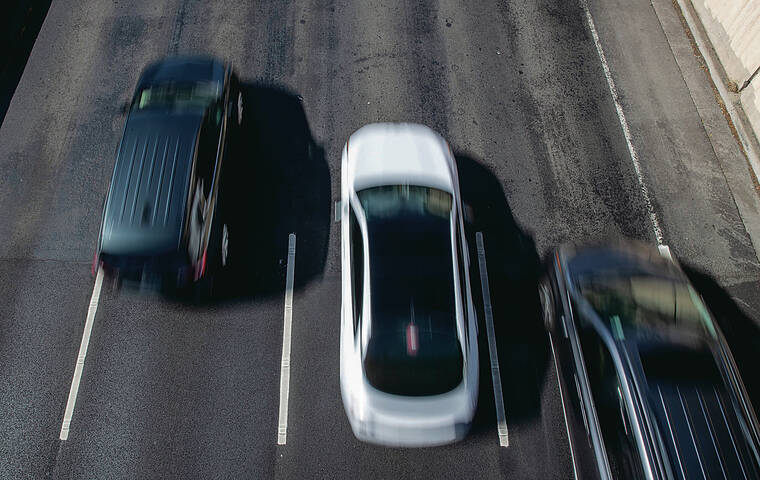
City transportation crews began a contraflow operation at 6:30 p.m. to expedite evacuations, reversing lanes to push traffic inland. “If you know somebody who’s stuck in traffic, place that call,” Blangiardi said, adding that police and traffic officials were stationed across the island to help direct drivers.
Acting Honolulu Police Chief Rade K. Vanic urged people to cooperate with officers and avoid unnecessary travel. “If you’ve arrived at a safe location — stay there,” Vanic said. “And if you don’t need to call 911, don’t. We need our officers to be able to respond to actual emergencies.”
Roger Morton, Director of the Department of Transportation Services, warned drivers on coastal roads such as Kamehameha Highway and Farrington Highway to assess their location immediately. “If you have any doubts, you need to get upslope immediately,” he said. “Now’s the time to get to high ground.”
Transportation officials also announced a major suspension of public transit operations that started at 6 p.m.
“We are planning to stop operating any trip that was scheduled to start after 6 p.m.,” Morton said. “Up until 6 p.m., we’re going to continue to operate trips.”
Morton noted that some buses might still be in inundation zones after 6 p.m. and could be detoured to higher ground to protect riders.
Emergency Medical Services Director Jim Ireland said EMS crews had been working nonstop, dealing with an “excess amount” of traffic accidents Tuesday. “We may not be able to respond into inundation zones until we get the all-clear,” Ireland said. “Get to higher ground. Take your time. Drive safely.”
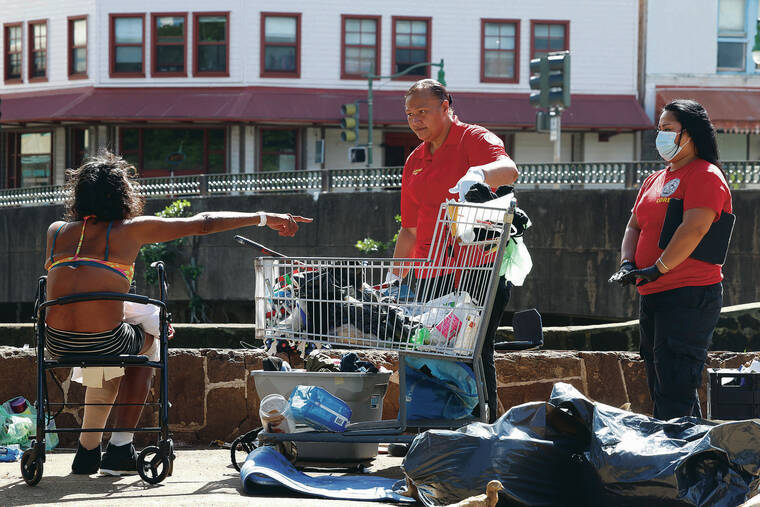
Ireland added that outreach workers had been deployed to coastal homeless encampments to notify people of the threat, but not all areas could be reached.
The mayor said Honolulu police were working to ease congestion, but acknowledged major traffic snarls across the island.
“I know we’ve gotten some calls,” Blangiardi said. “It is horrible, and people [are] in gridlock. All I could ask is for people to keep their calm and we’ll try to move things along as best we can.”
Emergency management officials were expected to provide further updates at 10 p.m. and 11 p.m. after press time for this story.