Group seeks interim rule to protect Molokai from invasive beetles

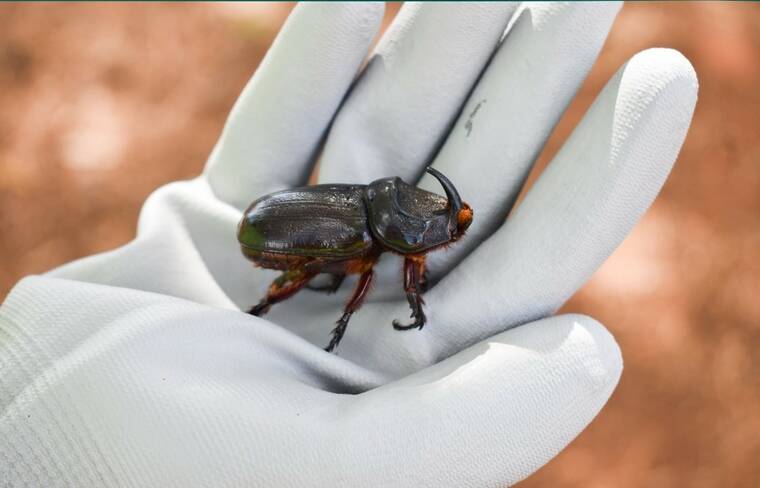
COURTESY DEPARTMENT OF AGRICULTURE
A coconut rhinoceros beetle is shown in this undated photo.
Some Molokai residents are pushing the state to halt to the shipment of plants, mulch and compost to their island for one year to prevent the spread of invasive coconut rhinoceros beetles.
Molokai, they said, is the last populated isle in Hawaii without any confirmed reports of the invasive pest, which destroys palms by boring into their fronds to feed on leaves and sap.
“If this thing takes off, it’s going to ruin the future of our tree of life,” said petitioner Kunani Nihipali. “It’s a tree that has provided for eons of Polynesians and Hawaiians. As a canoe plant, it’s a sacred plant that was part of childbirth through adulthood to death.”
Kunani and Ipo Nihipali, who are part of the Niu Now movement, in July filed a petition with the Hawaii Department of Agriculture & Biosecurity asking for an interim rule prohibiting the transport of plants, soil, compost, and other materials potentially hosting the invasive beetles from any other part of the state to the island of Molokai.
The petition is on the agenda for the Board of Agriculture & Biosecurity’s meeting scheduled to begin at 9 a.m. Tuesday.
Nihipali considers it a “last stand” against the disastrous invasive beetles, which were recently detected for the first time among shipments of plants to the island of Lanai.
Don't miss out on what's happening!
Stay in touch with breaking news, as it happens, conveniently in your email inbox. It's FREE!
In June and July, larvae as well as a live, adult coconut rhinoceros beetle were detected among potted plants shipped to Lanai.
Nihipali, who is part of Niu Now, a movement reviving coconuts as a vital part of Hawaii’s culture and history as well as a fundamental food crop, says the state needs to take stronger, more immediate action to protect Molokai.
CRB were first discovered in tree trimmings near a golf course at Joint Base Pearl Harbor-Hickam in December 2013 and had only been found on Oahu for about a decade. In 2023, the beetles spread to neighbor islands, and were detected on Kauai, Hawaii island, and Maui, but had not been reported on Lanai or Molokai.
On Oahu, the beetles have already decimated hundreds of palms — from the leeward to the windward side — and on much of the North Shore.
Molokai is home to original coconut groves planted by Hawaiian royalty for medicinal uses, said Nihipali. The loss of coconut palms would not only affect food security, but irreversibly damage the isle’s environment.
The Sierra Club is helping to gather testimony in support of the petition, saying that state leadership is “recommending this petition be rejected because, among other ludicrous reasons, they will only reduce and not totally eliminate the potential for CRB to be introduced to Molokai.”
Nihipali plans to attend Tuesday’s board meeting to testify in person and says the petition as of today has received nearly 300 letters of support. He wants more accountability from the state, and the opportunity to have a dialogue about the proposed rules.
“They’ve given up hope on the fact that prevention is a part of it,” he said, when they should be taking more steps to prevent it. “Every shipment that comes in could be detrimental in bringing this over… We want immediate remedies.”
The proposed interim rule would prohibit the interisland movement of any potted or bare rooted plants, along with landscaping materials, mulch, compost, soil, gravel, wood chips, and erosion control socks from any other part of Hawaii to Molokai.
Currently, the Department of Agriculture & Biosecurity has an interim rule restricting the shipment of certain palms, compost and other plant materials from Oahu to other islands through October.
The department’s plant quarantine branch noted, however, that if implemented as proposed, the interim rule “would reduce the risk of introduction of CRB to Molokai,” but “would not prevent it.”
It also said the proposed interim rule is drafted with measures that are “precedent setting” and “more restrictive than necessary,” and could potentially be in violation of the Commerce Clause.