North Shore eyeing shuttle service to solve traffic woes


MICHELLE BIR / SPECIAL TO THE HONOLULU STAR-ADVERTISER
Global tourists flock to Laniakea Beach for a chance to see renowned turtles, Laniakea Beach, Nov. 2, 2025

MICHELLE BIR / SPECIAL TO THE STAR-ADVERTISER
Tourists flocked Sunday to Laniakea Beach for a chance to see green sea turtles on the North Shore at Laniakea Beach. The flood of visitors creates traffic congestion.

MICHELLE BIR / SPECIAL TO THE STAR-ADVERTISER
House Majority Leader Sean Quinlan has secured $4.7 million to help untangle traffic snarls on Oahu’s North Shore.
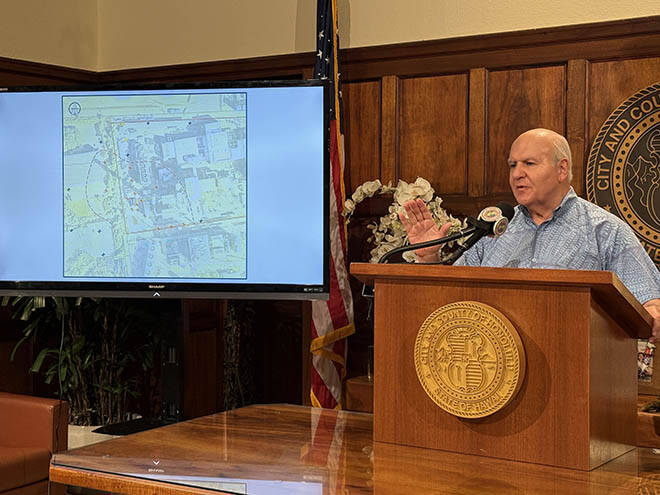
House Majority Leader Sean Quinlan has secured $4.7 million to help untangle traffic snarls on Oahu’s North Shore and is negotiating to purchase seven acres from Dole Food Co. — an integral step in starting a shuttle system aimed at easing traffic.
Quinlan (D, Waialua-Haleiwa-Punaluu) said Friday that he is trying to purchase the land adjacent to the Haleiwa roundabout, estimating its market value at $3 million. The remaining funds will cover the creation of a gravel parking lot, portable restrooms, signage and due diligence costs, including an environmental impact statement, he said.
The state Department of Transportation also has begun construction on a Laniakea Beach bypass. The project includes relocating the beach’s parking lot from the mauka to the makai side of the highway, improving pedestrian safety and traffic flow. Together, the developments lay the groundwork for a North Shore shuttle system modeled after Kauai’s Hanalei Initiative, which has reduced tourism-related traffic.
“The bypass and parking lot appropriation is in the neighborhood of $12 million. I worked on it for 10 years, and my father Bill Quinlan, who was on the North Shore Neighborhood Board, worked on it before me,” Quinlan said. “Traffic on the North Shore has been a community pain point for at least 15 years.”
Quinlan said the community is still shaping its long-term traffic strategy, but initial plans include encouraging visitors to park at the new Haleiwa lot and take a shuttle to high-traffic areas like Laniakea Beach Park. Permanent restrooms could be added to the Haleiwa site later.
Quinlan said he is painfully aware that traffic and parking management is needed to improve the quality of life for North Shore residents.
Don't miss out on what's happening!
Stay in touch with breaking news, as it happens, conveniently in your email inbox. It's FREE!
“I know people who have changed their children’s schools or moved away because the traffic is miserable,” he said. “If my 7-year-old son asks to go see his grandmother on a Saturday at 1 p.m., I have to tell him that we have to wait. The distance between our houses should be 18 minutes, but with traffic it can take more than an hour. We have turned into Waikiki’s backyard.”
Kathleen Pahinui, chair of the North Shore Neighborhood Board, said Laniakea Beach — a popular spot for viewing endangered green sea turtles — is a major contributor to traffic jams. The lack of safe pedestrian crossings and parking has led to dangerous conditions, including a 2019 incident where a 10-year-old boy was seriously injured crossing the highway.
Pahinui said the North Shore’s traffic problems are particularly acute for those that live near Sunset Beach, which is about 4 miles away from Laniakea Beach.
“I feel for everyone that lives over there because the planning that has to go into one’s day takes its toll,” she said.
Visitor traffic
Nearly 45% of U.S. West visitors to Oahu made a trip to the North Shore during their stay, making it the most visited region outside of Honolulu and Waikiki for the state’s core visitor market, according to the state Department of Business, Economic Development and Tourism’s second-quarter Visitor Satisfaction and Activity Report.
But the area’s popularity has intensified long-standing concerns over traffic and parking — issues that dominated recent Hawai‘i Tourism Authority meetings aimed at updating Oahu’s Destination Management Action Plan, which sets guidelines for managing tourism.
Caroline Anderson, HTA interim president and CEO, said in an email Friday that, “Parking and traffic concerns have been a major theme in what the North Shore community has been sharing with us throughout the Destination Management Action Plan process.”
At a Sept. 24 community meeting in Central Oahu, Anderson said residents cited traffic, parking shortages, strained infrastructure, and overcrowding — particularly along the corridor from Haleiwa to Turtle Bay. Hot spots like Laniakea, Chun’s Reef, Waimea Bay and Shark’s Cove were singled out as especially congested.
Anderson said community members have proposed solutions such as designated parking areas paired with shuttle services to reduce the number of cars on the road.
North Shore residents have intensified their grassroots efforts to address longstanding traffic and parking challenges in the region. North Shore Transportation Alternatives, a nonprofit marking its first anniversary, is working with Quinlan and others in the North Shore community to stand up a shuttle system to tackle chronic traffic and parking congestion.
North Shore Transportation Alternatives President Karen Gallagher said an early vision would require visitors to park at a designated lot and use circulating shuttles to access Haleiwa and, eventually, popular spots like Waimea Bay, Laniakea or even Turtle Bay. She said the goal is to restore local beach access, reduce carbon emissions and reinvest visitor fees into the community.
While Oahu’s North Shore traffic plan is still evolving, Pahinui said the community will have a chance to weigh in before any rollout.
“If we could get even 30 cars off the road, it would be a huge start,” she said.
Gallagher said eliminating nonresident parking from some of the spots would incentivize visitors to park and use the shuttle system. Gallagher said the group also is hoping to provide free shuttle rides to locals.
Pahinui said proposals also include implementing beach reservation systems, and reviewing commercial tour operations.
Gallagher said that the group is seeking grant funding for transportation planning and hopes to launch the shuttle system within two years — well ahead of the city’s six-year mobility hub timeline.
“We’re excited to work with the city and state to make this happen,” she said. “We’re in the traffic every day, and we want this done as soon as possible.”
Hanalei Initiative
Gallagher and Pahinui recently were part of a hui that visited Kauai to study the Hanalei Initiative, which manages traffic and parking on the Kauai’s North Shore. The group also included Racquel Achiu, vice chair of the North Shore Neighborhood Board; Denise Antolini, the board’s traffic lead; and former state Sen. Gil Riviere.
Joel Guy, executive director of the nonprofit Hanalei Initiative, said Kauai’s North Shore launched its shuttle system in 2019 with $1.5 million in flood relief funds that were awarded to the county. The service debuted alongside the reopening of Haena State Park under a new reservation system following a prolonged flood-related closure.
Initially, the Hanalei Initiative operated only the shuttle, serving 250 to 300 riders daily, while a for-profit company managed parking and other site operations for the state. Post COVID-19 , the nonprofit — partnering with the Waipa Foundation and Hui Maka‘ainana o Makana — took over full operations, including parking, overnight stays, day-use access, and revenue management.
Since then, shuttle ridership has doubled to 500-550 passengers daily. With no financial incentive to sell parking, the system encourages shuttle use and has significantly reduced traffic in Hanalei.
The initiative partners with Polynesian Adventure Tours for larger-capacity vehicles when needed, but also owns nine smaller electric vans for more flexible service. It now employs more than 45 local lineal descendants, offering benefits such as paid time off, health insurance with dental and vision care, and 401(k) plans.
“The management system between the state and the community has been transformational,” Guy said. “We aren’t looking for subsidies. We are reinvesting hundreds of thousands of dollars back into our community based off the shuttle system. It’s also reduced the congestion in our town by hundreds of cars everyday.”
Hui Maka‘ainana o Makana is also building a $1.7 million state-of-the-art comfort station at the park, funded entirely through entrance fees — not taxpayer dollars, Guy said.
He believes Oahu’s North Shore could benefit from a similar model.
“Each community has unique challenges that they need to figure out how to overcome. I don’t think it makes sense for someone from Haena to come over there and tell them how to do it, but there is a lot of stuff that we could share,” he said. “Do I think they could be successful? 100%.”
Quinlan echoed that optimism, expressing hope that North Shore nonprofits and community members will collaborate with city and state agencies to manage traffic. He envisions reservation systems at all city beach parks on the North Shore and using shuttle revenue to fund community improvements — from beach erosion mitigation to upgraded restrooms. Eventually, he said, the shuttle could expand to other congestion hot spots on Oahu’s North Shore.