4 years after fuel leak, Board of Water Supply continues Red Hill remediation

GEORGE F. LEE / 2023
Inside Upper Tank No. 19 at the Red Hill Fuel Storage Facility in Halawa Valley.
Four years ago today, a massive jet fuel leak forever changed the Navy’s operations at its once-top-secret, underground Red Hill Bulk Fuel Storage Facility in Halawa Valley.
In its aftermath, the Honolulu Board of Water Supply says it continues to detect related fuel spill contamination in several city-owned drinking wells across Leeward Oahu.
And BWS notes that while the Navy works to permanently shut down the World War II-era Red Hill facility, constructed just 100 feet above an aquifer that supplies most of Honolulu’s drinking water, the military branch is also attempting to reactivate separate, non-city wells, to further supply potable water to Joint Base Pearl Harbor-Hickam.
On Wednesday, BWS Manager and Chief Engineer Ernie Lau lamented the 19,000-gallon jet fuel leak at the Red Hill facility on Nov. 20, 2021 — as well as previous toxic spills at the fuel farm, likely dating back to its initial opening in 1943 — caused a near catastrophe for Oahu’s fresh water supply.
“We are approaching the fourth-year remembrance of a terrible event that occurred in 2021, when 93,000 people were exposed to fuel contaminated drinking water in their homes on Joint Base Pearl Harbor-Hickam,” Lau told the City Council’s Committee on Infrastructure, Transportation and Technology. “This is a time to remember, and not to forget, because the work is still ahead of us, and there is a need to think about this challenge in an inter- generational approach.”
He added “this is not a problem that will be resolved in one generation — in my generation — it will take generations to come to resolve this.”
Don't miss out on what's happening!
Stay in touch with breaking news, as it happens, conveniently in your email inbox. It's FREE!
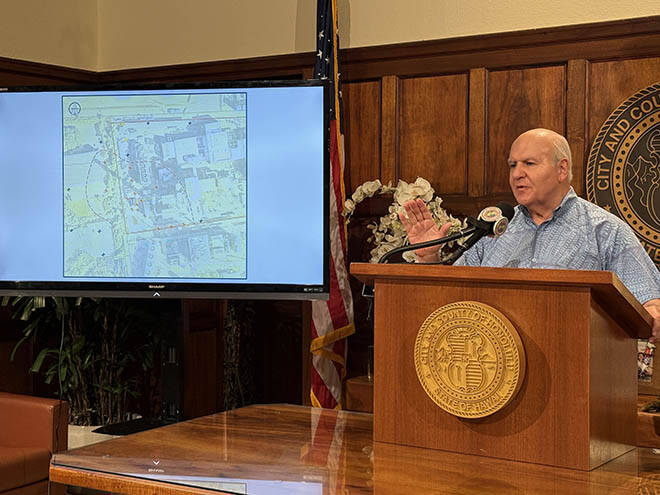
During a subsequent informational briefing to the committee, BWS civil engineer Joyce Lin said her agency has kept Halawa Shaft closed as well as two wells in Aiea and three others in Halawa.
Lin also noted fuel contamination in the groundwater continues to flow in a westerly direction, from Halawa Valley toward Aiea.
Because of this underground contamination, she said “we’ve been doing more regular sampling.”
“Also as a response to the fuel spill, the Navy had started constructing monitoring wells to capture water data in our aquifer trying to see where the potential plume may be going,” Lin said. “And, also at the same time, (BWS) has been trying to develop our own monitoring well system outside the Red Hill Bulk Fuel Storage Facility.”
She said the Navy’s monitoring wells are within the Red Hill facility itself, while BWS monitoring wells are west of the shuttered Halawa Shaft.
Lin noted BWS’ monitoring wells are in “different phases” of design and construction. “So we have approximately five monitoring wells that have been completed in construction,” she said.
Those area monitoring wells are located near the Halawa Correctional Facility, Halawa District Park, and the state Department of Agriculture’s Animal Quarantine Station, she added.
“And we have some monitoring wells further west,” Lin said. “So we have a few that we are planning near Ka‘amilo Wells … and we have a few near our Halawa Shaft that are currently in design and should be going out for bid towards the end of this fiscal year,” on June 30.
The Navy, according to Lin, also is doing work to reactivate its own separate water supply sources to service the joint base. “They rely on three wells to provide drinking water,” she said.
Those sites are the Red Hill Shaft, the Aiea-Halawa Shaft and the Waiawa Shaft in the Pearl City industrial area, she said.
“The Navy has been trying to bring the Aiea-Halawa Shaft back online, as well as the Red Hill Shaft, to kind of provide redundancy to their water system,” Lin added. “From what we know they have applied to reactivate their source at the Aiea-Halawa Shaft,” with the state Department of Health earlier this year.
The Navy also installed water treatment equipment near the Aiea-Halawa Shaft to treat for per- and polyfluoroalkyl substances, or PFAS, and other toxic contaminating chemicals, Lin said.
“And then also at the Red Hill Shaft they actually are going in for a temporary water treatment system as well as a permanent treatment system to bring that source back online,” she said.
And Lin asserted that as part of Congress’ continuing resolution, which restored federal government funding through Jan. 30, it allotted more than $140 million toward the Navy’s remediation and treatment system at Red Hill.
For its part, BWS also has been active in PFAS detection.
Lin noted BWS’ attempts to boost water treatment at the critical Ka‘amilo Wells in the Aiea-Halawa area have begun. “We have actually been detecting PFAS … at our Ka‘amilo Wells,” she said. “So we decided in May to actually shut down this source; we didn’t want to provide that water to anyone before we came up with a solution.”
Although the long-term plan is to open an estimated $20 million permanent water treatment system at or near the same site, BWS will install a temporary water treatment system in the meantime.
Lin said the new treatment system will feature two 16-foot tall, 12-inch diameter granular activated carbon, or GAC, filled metal vessels “to help treat some of the PFAS contaminants that we’re picking up at this well.”
“We started construction at this site already,” she said, “and we’re working on connecting the pipelines to the source and the (GAC) treatment vessels.”
Meanwhile, BWS’ federal lawsuit over the Navy’s fuel leaks at the Red Hill facility is also pending adjudication.
Filed in July as a federal civil tort complaint in the U.S. District Court of Hawaii, BWS says it’s suing the Navy “for negligence, nuisance, and trespass resulting in damages where the government of the United States of America, if a private party, would be liable to the BWS.”
BWS estimated the cost of past, current and future impacts from the fuel leaks at $1.2 billion.
This week, BWS spokesperson Kathleen Elliott-Pahinui told the Honolulu Star-Advertiser that the case — the Board of Water Supply v. United States of America — is now assigned to Senior Judge Leslie E. Kobayashi.
“Given the ongoing nature of the litigation, BWS has no further comment at this time,” Elliott-Pahinui said.
The Navy did not immediately respond to questions about BWS’ ongoing lawsuit either, or to inquires involving its efforts to reactivate potable water sources meant for Joint Base Pearl Harbor-Hickam.