Hawaii legislative bills advance to unmask ICE agents

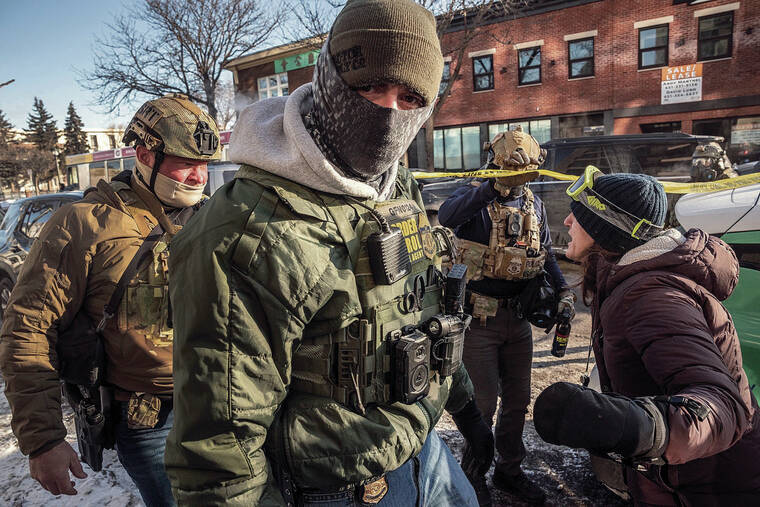
DAVID GUTTENFELDER / THE NEW YORK TIMES / JAN. 24
Hawaii lawmakers say communities are demanding action on federal immigration enforcement after recent protests and the fatal shootings of American citizens by federal agents in Minneapolis. Masked federal agents confront protesters in Minneapolis.

STAR-ADVERTISER
Karl Rhoads
The first of several Hawaii legislative bills that would unmask federal Immigration and Customs Enforcement agents was met with concerns Tuesday from the Honolulu Police Department and state Department of Law Enforcement that backup officers from their departments also could be identified while supporting local undercover operations.
No representatives for ICE or any federal agency testified before the Senate Judiciary Committee or submitted written testimony regarding SB 2203.
But HPD and DLE representatives testified before the Senate Judiciary Committee that they’re concerned that their backup officers who support their undercover operations — by maintaining a police perimeter, for example — could be identified and would make it difficult for them to serve in future undercover operations.
“The bill already exempts officers undercover,” Judiciary Chair Karl Rhoads (D, Nuuanu-Downtown-Iwilei) told HPD Maj. Manuel Hernandez and DLE Deputy Director Jared Redulla. “But then your argument is that there are, like, a category of people who aren’t yet undercover?”
Rhoads called a possible exemption for backup officers “a huge loophole.”
The Honolulu Prosecutor’s Office would be responsible for prosecuting any new state laws banning officers from covering their faces on Oahu, including ICE agents.
Don't miss out on what's happening!
Stay in touch with breaking news, as it happens, conveniently in your email inbox. It's FREE!
The Prosecutor’s Office said in written testimony that, “California became the first state to enact a mask ban for federal and local officers. The Department of Justice sued in response, seeking a court order that the ban was unenforceable against federal agents. Under the Supremacy Clause, states cannot directly regulate the actions of the federal government.
“Because the Tenth Amendment reserves the general police power to the states, state criminal law ordinarily harmonizes with federal supremacy,” prosecutors wrote. “But when a state seeks to criminally punish a federal officer for acts undertaken in the course of federal duty, the danger of state intrusion on federal interests is especially grave.”
State Sen. Joy San Buenaventura (D, Puna), however, insisted that “anybody who abuses their power needs to be identifiable.”
The Judiciary Committee deferred SB 2203 to Thursday — but only after Rhoads said there is a clear demand in Hawaii to respond to ICE immigration operations, especially following the separate shooting deaths of two demonstrators in Minneapolis in January.
In addition to in-person testimony over SB 2203, Tuesday’s Judiciary hearing also received 151 pages of written testimony that was overwhelmingly in favor.
“This bill and others are almost assuredly going to move,” Rhoads said. “You saw the amount of support for them and the visceral anger against what’s happening in Minnesota right now. We’re going to have to deal with this one way or the other. … Something’s going to move.”
Mandy Fernandes, the policy director of the ACLU’s Hawaii chapter, said, “we are supportive and open to different ways this can work. … Even if we fully trust our local police departments that they’re doing this the right way, we know that’s not the case with our federal agents. So we need to come to some sort of solution.”
Gov. Josh Green’s office said in a statement to the Honolulu Star-Advertiser following Tuesday’s Judiciary Committee hearing that “Governor Green is supportive of sensible bills that protect law abiding members of our community.”
SB 2203 would make it a misdemeanor for any law enforcement officer who “wears a mask or personal disguise while interacting with the public in the performance of the law enforcement officer’s duties.”
It makes exceptions for undercover officers; motorcycle officers as long as they remove their covering before and after riding a motorcycle; the use of medical-grade masks to prevent airborne diseases; equipment needed for underwater operations or weather protection; “during a state of emergency related to a wildfire;” or as “protective gear used by law enforcement officers necessary to safely perform official duties as a member of the specialized services division, a special weapons and tactics team, or a special response team.”
Other bills moving in the House and Senate also would ban officers from covering their faces, in addition to other requirements that they identify themselves and their vehicles as law enforcement.
The House Economic Development and Technology Committee is scheduled to hear three of them on Friday, including HB 2540, the House companion bill to SB 3322.
Both bills would prohibit face coverings and also require law enforcement officers to wear “visible identification,” including identification on their vehicles.
State and county law enforcement agencies also would have to establish policies regarding their cooperation with federal civil immigration enforcement. Officers also would be prohibited “from prolonging a stop to inquire about a person’s civil immigration status.”
The House Economic Development and Technology Committee on Friday also is scheduled to hear HB 1886, which would require standards dictating facial coverings and identification, and would further require “that when federal law enforcement officers arrest a person without a warrant, that it is done so in their personal capacity.”
The Economic Development and Technology Committee on Friday also will consider HB 1839, the House companion bill to SB 2874.
Both bills would require state and county law enforcement agencies to “notify an individual in the custody of a state or county law enforcement agency of their rights before any interview with the United States Immigration and Customs Enforcement pertaining to certain matters regarding civil immigration violations can commence.”
>> SB 3265 and HB 2129 have similar provisions to SB 3322 and would also require “certain locations to be service-first spaces and requires them to have clear, narrowly tailored procedures with respect to civil immigration actions.” All state and county agencies also would be required to adopt policies “that limit the collection, retention, and sharing of immigration-related personal data” in addition to annual reports to the Legislature and governor involving “civil-immigration-related requests.”
Both bills also would require every state and county agency to adopt a policy that “prohibits immigration-based harassment or threats, including unwarranted verification of an individual’s immigration status, with respect to employment or the provision of services to the public.”
Every local agency also would be required “to monitor civil immigration enforcement activity by activating body cameras when present in a situation in which United States Immigration and Customs Enforcement agents are interacting with a member of the general public.”
Other immigration-related bills include HB 2541, which would prohibit discrimination based on a person’s immigration status; and HB 2445, which would require the state Department of Education to develop a standardized emergency response plan for immigration enforcement activities on or near public schools across the state.