Lava fountains hit 1,300 feet before Kilauea Episode 42 ends


U.S. GEOLOGICAL SURVEY
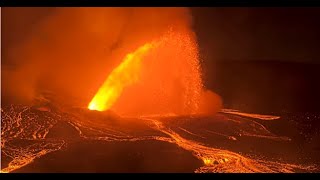
A screenshot of the view from Halemaumau crater from the southern rim of the caldera on Sunday. The dramatic display at Kilauea’s summit has hit the pause button.
UPDATE: 6:50 a.m.
The dramatic display at Kilauea’s summit has hit the pause button.
Episode 42 of the ongoing Halemaumau eruption ended at 11:38 p.m. Sunday after nearly 10 hours of high-intensity fountaining that transformed the crater floor.
The Hawaiian Volcano Observatory reports that while the eruption is currently paused, the episode was a powerhouse of activity. At its peak around 3:00 p.m. Sunday, the volcano was pumping out lava at a rate of 1,000 cubic yards per second.
In total, an estimated 15 million cubic yards of molten rock erupted, covering roughly 50% of the Halemaumau crater floor.
Fountains from the south vent were the stars of the show, reaching heights of 1,300 feet, while the north vent held its own at 1,000 feet.
Don't miss out on what's happening!
Stay in touch with breaking news, as it happens, conveniently in your email inbox. It's FREE!
Despite the scale of the fountaining, community impacts remained relatively light. Residents in Pahala, Punaluu and Naaehu reported fine ash and Pele’s hair, but the strong tradewinds from the northeast helped push the majority of the material away from populated areas.
The volcano alert level remains at watch and the aviation color code at orange.
EARLIER COVERAGE
Kilauea volcano roared back to life today as a new episode of lava fountaining began within the Halemaumau crater.
The Hawaiian Volcano Observatory raised the volcano alert level to watch and the aviation color code to orange after the activity started at 1:50 p.m.
This latest activity, designated as Episode 42, is currently confined to the summit caldera within Hawaiʻi Volcanoes National Park. Ground sensors indicate that winds are blowing from the northeast, which is expected to carry volcanic gas and fine material like Pele’s hair and ash to the southwest.
>> RELATED: High surf hits east shores as ashfall advisory posted
While the lava remains contained within the crater, HVO officials warn that sulfur dioxide emissions are surging, typically reaching between 50,000 and 100,000 tonnes per day during these events.
Residents and visitors are advised to minimize exposure to volcanic fragments and vog, which can cause skin, eye and respiratory irritation. Past episodes in this series have generally lasted a day or less.