Military targets are initial focus of U.S. strikes in Iran

PLEIADES NEO AIRBUS DS 2026 via REUTERS
A satellite image shows black smoke rising and heavy damage at Iranian Supreme Leader Ayatollah Ali Khamenei’s compound in Tehran, following strikes by the United States and Israel against Iran today.
The scope and scale of the coordinated strikes by the United States and Israel against Iran that began early Saturday appear to be far more extensive than the military operation ordered by President Donald Trump against Iran last June, with Trump saying the new campaign would be “massive.”
In the initial wave, the U.S. carried out dozens of strikes with attack planes launched from bases around the Middle East and from one or more aircraft carriers, a U.S. official said. The warplanes are part of the largest U.S. military buildup since the Iraq War in 2003, and the deployment includes two aircraft carriers, a number of naval destroyers and more than 50 fighter planes.
The focus of the American strikes for the moment is military targets in Iran, a U.S. official said. Besides its nuclear facilities, Iran is believed to have more than 2,000 missiles, primarily short- and medium-range ballistic missiles that threaten Israel and U.S. forces across the region. Those missiles are scattered at launch sites across Iran and were among the first targets, U.S. military officials said.
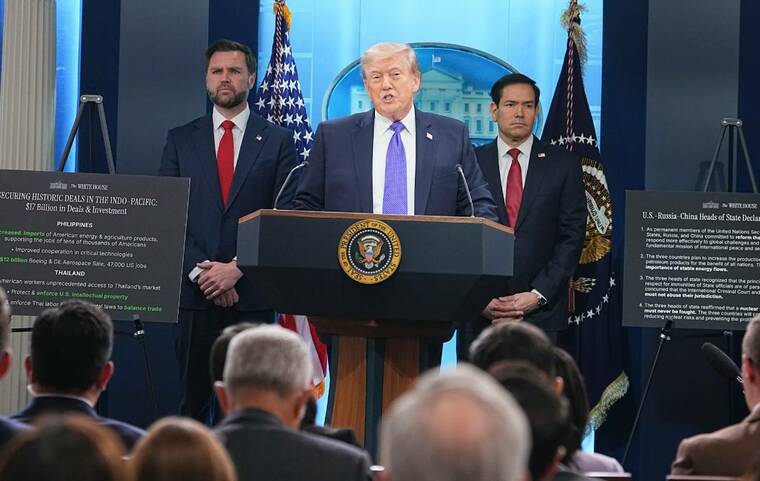
“We are going to destroy their missiles and raze their missile industry to the ground,” Trump vowed in an eight-minute video posted on social media early Saturday.
The president suggested that the aim was to destroy much of Iran’s substantial military capability.
“We’re going to annihilate their navy,” Trump said in the video. “We are going to ensure that the region’s terrorist proxies can no longer destabilize the region or the world and attack our forces and no longer use their IEDs or roadside bombs, as they are sometimes called, to so gravely wound and kill thousands and thousands of people, including many Americans. And we will ensure that Iran does not obtain a nuclear weapon. It’s a very simple message.”
Don't miss out on what's happening!
Stay in touch with breaking news, as it happens, conveniently in your email inbox. It's FREE!
Iran’s Revolutionary Guard, a theology-driven force that reports directly to the Iranian supreme leader, is estimated to have close to 200,000 members. Iran has a fleet of hundreds of fast boats that specialize in swarm attacks in the Persian Gulf. It has a massive arsenal of 3,000 to 6,000 naval mines that can enable it to temporarily close off the Strait of Hormuz.
The scope of the American attacks carries huge risks, as Trump acknowledged in saying that the campaign could result in U.S. casualties. Gen. Dan Caine, the chair of the Joint Chiefs, had cautioned Trump in recent private meetings that U.S. troops could be killed or injured.
Trump seemed to acknowledge Caine’s warning, and appeared to already be taking steps to shield himself from what will certainly be an avalanche of criticism if there are substantial U.S. casualties. The Pentagon had moved some troops in the region to different locations in advance of Saturday’s attacks.
“My administration has taken every possible step to minimize the risk to U.S. personnel in the region,” Trump said.
“Even so, and I do not make this statement lightly, the Iranian regime seeks to kill,” he said. “The lives of courageous American heroes may be lost and we may have casualties.”
He added: “That often happens in war.”
U.S. officials say they expect the strikes on Iran to extend for several days, if not weeks. Trump, in his remarks, suggested that he wanted to overwhelm the Iranian military to the point that its more than 600,000 troops — and even its police force — give up any fight.
“To the members of the Islamic Revolutionary Guard, the armed forces and all of the police, I say tonight that you must lay down your weapons and have complete immunity, or, in the alternative, face certain death,” Trump said.
Two U.S. military officials said Friday that it was unclear whether Trump and senior officials who were pushing for the sweeping military operation understood the depth of many Revolutionary Guard members’ distaste for the United States, or the complexities of the forces that this military campaign may unleash.
———
This article originally appeared in The New York Times.
© 2026 The New York Times Company