Tech-focused Kalihi charter school sees academic progress
JAMM AQUINO / JAQUINO@STARADVERTISER.COM
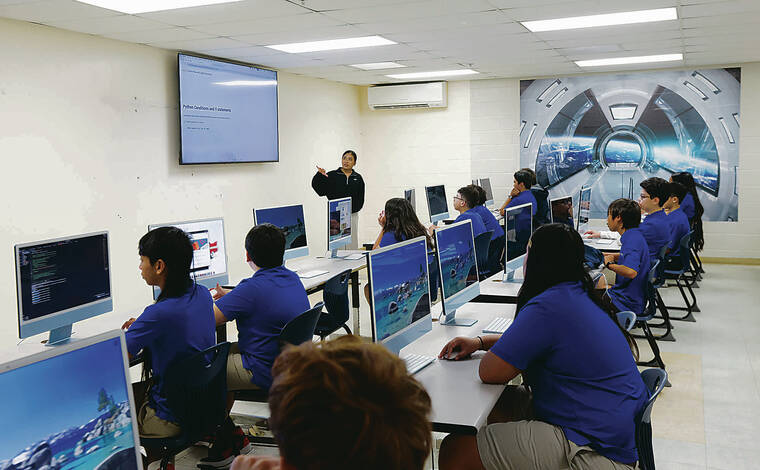
Instructor Aileen Abitong conducted computer class Wednesday with her students at Kulia Academy, the first school in the United States to offer a comprehensive 7-year Artificial Intelligence and Data Science program.
JAMM AQUINO / JAQUINO@STARADVERTISER.COM
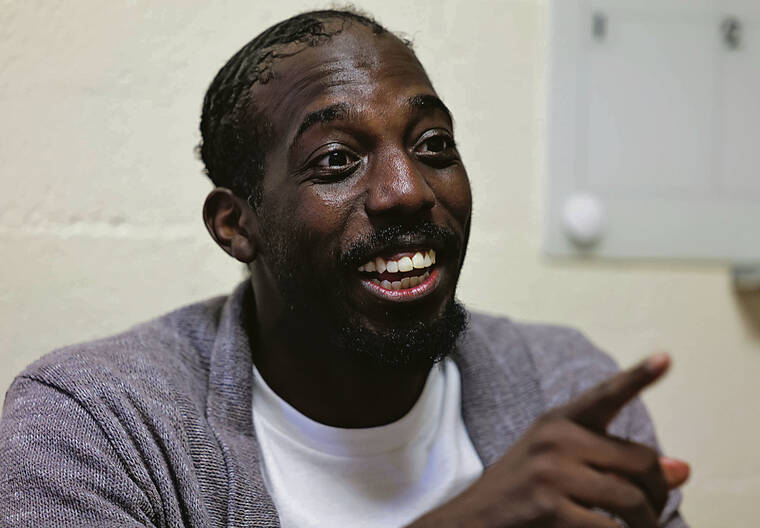
Kelvin Frazier:
The Massachusetts Institute of Technology doctorate was drawn to teach at the Kulia Academy after learning of the school’s ambitious AI focus
JAMM AQUINO / JAQUINO@STARADVERTISER.COM
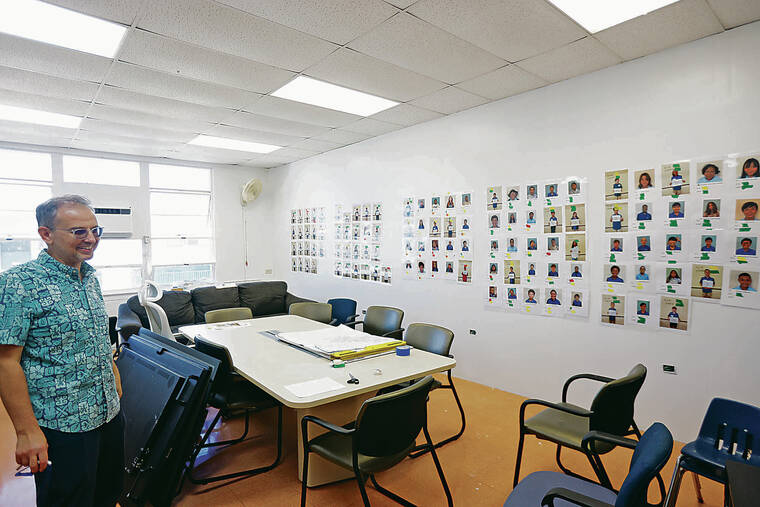
Kulia Academy Principal Andy Gokce showed a wall that tracks students’ progress using their portraits tagged with academic color codes.
At Kulia Academy, the last hour of the school day looks less like dismissal and more like momentum.
Sixth grader Jack Nakai counts down to Thursdays and Fridays — not for early dismissal, but for extra math.
“It sounds boring,” the 12-year-old said. “But it’s actually really fun. Lots of challenges and little competitions.”
Jack, who recently celebrated his birthday at school by training a machine-learning model to identify different species of snakes, is part of a growing experiment in Hawaii education: a longer school day, no homework and a seven-year artificial intelligence and data science pathway that starts in middle school.
On the 2024-25 Strive HI state assessments, Kulia 6th-grade students earned the highest proficiency rates among Hawaii middle schools — 75% in math and 80% in English language arts. According to school data, students averaged 2.4 grade levels of growth in math and 2.6 in English Language Arts in a single year.
Earlier this year, lawmakers including state Sen. Donna Mercado Kim and state Reps. Julie Reyes Oda and Justin Woodson honored the Kalihi charter school for posting the top statewide scores.
Don't miss out on what's happening!
Stay in touch with breaking news, as it happens, conveniently in your email inbox. It's FREE!
But administrators and parents say the bigger shift is cultural.
“Being smart is cool here,” said parent Chris Teijeiro.
His son Hendrix, now in seventh grade, struggled with motivation during the pandemic while attending Waikele Elementary School. After enrolling at Kulia through a lottery, Teijeiro said, his son “found his groove.”
“He’s working with drones in the summer and creating video games,” Teijeiro said. “Honestly, I don’t even understand a lot of what they’re learning — and I’m an adult.”
What he does understand, he said, is the shift in his son’s attitude.
“Now he thinks math is actually really cool.”
Teijeiro said the school has made learning engaging in a way he hadn’t seen before. His son enjoys coding, is inspired by his older sister studying computer science at the University of Hawaii, and is surrounded by classmates who are equally motivated.
“Everything feels interesting to him,” Teijeiro said. “He’s meeting other kids who are driven. There are so many opportunities here. I just hope he can stay through high school.”
Kulia’s structure departs sharply from traditional models. The school operates 200 days a year — 20 more than most public schools — and runs from 8 a.m. to 4 p.m., with optional drop-off as early as 7 a.m. and pickup as late as 5 p.m.
There are no short days, and no homework.
“The policy of no homework makes a lot more sense,” said Kelvin Frazier, a seventh-grade math and AI teacher who holds a doctorate in physical chemistry from the Massachusetts Institute of Technology. “You can’t guarantee that students can do homework at home.”
Instead, the extended day is built around depth. Students receive two hours of math and two hours of English daily, with AI/data science alternating alongside science and social studies. From 3 to 4 p.m., students attend enrichment classes — debate, orchestra, math competitions — or targeted tutoring with their own teachers.
The longer hours are intentional, administrators say. If a student doesn’t understand a concept, teachers can reteach it immediately. Struggles aren’t sent home in a backpack.
“If students go home and have homework, they might not be able to do it themselves,” said Kulia Academy Executive Director Andy Gokce. “Here, we have the time.”
For Jack, the balance works.
“We don’t have to stress at home,” he said. “It balances out because we can do a lot of stuff.”
Outside of school, he spends his days off relaxing at home or playing baseball. But even then, he finds himself looking forward to coming back.
At the center of the school’s model is its seven-year AI and data science curriculum — launched after approval from the Hawaii State Public Charter School Commission in 2021 and the school’s opening in 2024.
Unlike many campuses that introduce coding through block-based programs such as Scratch, Kulia students type real code from the start — Python, JavaScript and HTML — while learning data analytics before progressing to AI algorithms.
Students are allowed to use artificial intelligence tools in certain contexts, but they are not permitted to rely on them to generate their code. The emphasis is on understanding the logic behind the technology.
“Our main concentration is to put them in the kitchen,” Gokce said. “We don’t want them just using AI. We want them to build it.”
Frazier said he was drawn to Kulia after spotting a job listing online and learning about the school’s ambitious AI focus.
“When I see something that could be impactful or growing, I like to be part of that,” he said. “I don’t like things that are already established and polished.”
The school’s emphasis on artificial intelligence — and building it from the ground up — appealed to him.
“Interfacing with AI, that’s very different. It’s uncharted territory,” he said. “A lot of people are scared of AI. Here, they’re teaching students how to use it in an impactful way — not letting AI think for them, but teaching them how it works.”
In the classroom, Frazier approaches math with flexibility and creativity. Students might learn fractions through music — a whole note equals four counts — or work through competitive “math jams” and games.
“Sometimes they’ll say, ‘I hate math,’” he said. “But if you make it relatable and interesting, they get engaged.”
He believes traditional models can leave students behind if they’re not immediately hooked. At Kulia, he said, the academic freedom allows him to experiment and adapt lessons to keep students motivated.
“When students are engaged and excited,” Frazier said, “that’s when real learning happens.”
For Jack, the work can be demanding. Debugging code requires patience.
“It’s not difficult,” he said. “It just requires more time.”
That mindset — persistence over panic — is one teachers say they deliberately nurture. When programs break or models fail, students are expected to rethink, test and try again.
Jack already imagines applying that mindset beyond middle school. He hopes to attend the California Institute of Technology, gain experience as a software engineer on the mainland and eventually return to Hawaii to help expand digital literacy.
While much of the outside world imagines Hawaii as palm trees and beaches, Jack envisions a different future — one where innovation rises alongside the skyline and the islands keep pace with the rest of the world in advanced technology. He wants to be part of that change and help drive that advancement.
“I think about AI changing the world often,” he said. “It’s predictable to see that AI is going to take over. It’s kind of scary, but if you’re ahead of the game, it’s not that scary.”
In the staff lounge, a wall covered with student photos reflects the school’s hands-on approach. Each child’s picture is marked with colored stickers: green for proficient and ready for the state test, yellow for nearly there, red for needing additional support.
Teachers update the board regularly, discussing students by name and coordinating interventions.
Unlike many middle schools where teachers may oversee more than 125 students, Kulia instructors typically work with about 55. The smaller load, combined with extended time blocks, allows for closer monitoring and quicker support.
Students who fall behind attend tutoring during the enrichment period — often with the same teacher who taught the lesson earlier that day. The campus also prohibits cellphones and personal devices, keeping academic work supervised and on task.
Parents say the academic growth is evident at home.
Louisa Holty makes the daily drive from Kailua so her daughter Trinity can attend Kulia — a commute she calls “1,000% worth it.”
Before enrolling, Trinity had never earned straight As. Now, she’s in advanced classes.
“Now she wants to work for NASA. She’s very confident, and that makes me confident too,” Holty said. “Her attitude changed tremendously. She’s very proactive. She doesn’t want to go home — she loves being here at school.”
Holty credits the shift to the school’s approach.
“The teachers make it so fun. The students all get along. There are no problems,” she said.
She believes the model — longer days, deeper instruction and an emphasis on STEM and AI — is something Hawaii needs more of.
“This model of learning is great. We never had this before,” Holty said. “We need more facilities, I hope that more people will invest into this school. I’d rather have her here than in a private school.”
Demand for Kulia, which operates out of rented space at St. John the Baptist Church in Kalihi, now stretches from Mililani to Kailua. Some students commute by bus and rail; others endure long drives.
Administrators say expansion would ease transportation burdens and meet growing interest.