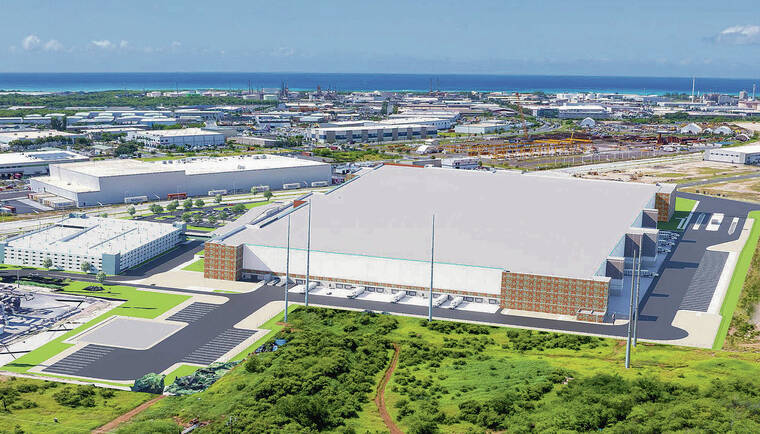
West Oahu refinery to produce plant-based biofuels

JAMM AQUINO / JAQUINO@STARADVERTISER.COM
Par Hawaii refinery at Campbell Industrial Park in Kalaeloa, shown Thursday, is set to start a new renewable fuels facility on its current 100-acre property.
Par Hawaii Refining LLC, a more than 50-year-old petroleum refinery in James Campbell Industrial Park, says this month it will start up the largest renewable fuel production facility in Hawaii.
Originally founded in 1972, the company owns the state’s only petroleum refinery, with a capacity to process 94,000 barrels of crude oil per day, and distributes fuels, via pipelines, on Oahu and barges the rest to all major harbors in the state.
But Par Hawaii proposes that part of its 151.4-acre facility at 91-325 Komohana St. in Kapolei will now produce low-carbon-emission, plant-based biofuels, including renewable diesel, sustainable aviation fuel and renewable liquefied petroleum gas, among others.
The company says its $100 million project involves a renewable hydrotreater, or RHT, and related equipment that uses biological materials, or feedstock like canola oil and similarly grown crops, that can be converted into biofuels.
“We expect our RHT to come online and start producing Hawaii’s first delivery of renewable fuels in March 2026, pending final commissioning and startup activities,” said Marc Inouye, Par Hawaii’s director of government and public affairs.
Once operating, the new facility eventually could produce 61 million gallons of renewable fuels annually, he said.
Don't miss out on what's happening!
Stay in touch with breaking news, as it happens, conveniently in your email inbox. It's FREE!
The renewable fuels project comes under a joint venture called Hawaii Renewables — a partnership between Par Pacific, the Houston-based parent company of Par Hawaii, and Alohi Renewable Energy LLC, which is composed of two Japanese companies, Mitsubishi Corporation and ENEOS Corp., according to Inouye.
“Par Pacific is the majority owner,” he said.
But before its project could fuel up, PAR Hawaii first had to obtain a zoning variance from the city Department of Planning and Permitting, as the RHT was planned to exceed the 60-foot height limit for the “intensive industrial district” within Campbell Industrial Park.
DPP spokesperson Davis Pitner confirmed the department’s director approved the zoning variance in November 2024, to allow the construction of a renewable fuel production facility.
Other city-issued permits remain under DPP scrutiny as well.
“Several building permit applications are in the pre-application phase, and (an application) is currently under review for the feedstock pipeline,” Pitner said.
According to Inouye, Par Hawaii’s renewable fuels project is one among a few companies — including Kings Energy Group in Alberta — that are involved in biofuel production.
“It’s kind of a game changer when we made this huge investment into our renewable fuels efforts,” he said. “We’re going from like maybe 6 million gallons of biodiesel that the Kings are making, to really 61 million gallons of renewable fuels here in Hawaii.”
“So quite a big difference,” Inouye said.
He noted renewable diesel “has potential to be used” by utilities like Hawaiian Electric Co. as well as for those running “heavy-duty trucks or boats.”
Likewise, Inouye said sustainable aviation fuel, or SAF, is “really desirable by the airline industry.”
SAF is a “drop-in” fuel, meaning it works with existing airplane engines and fuel infrastructure. Its current use, however, is limited to a maximum 50% blend with conventional jet fuel made from petroleum, and 100% SAF use may be several years away.
“They blend it with conventional jet fuel, depending on where we source our feedstock, our canola or soybean oil,” Inouye explained. “But it has a chance to reduce their emissions by 50% to 80%, which is very meaningful for airlines.”
Par Hawaii, he noted, has a “good partnership with Hawaiian Airlines,” though no sale of SAF has been made to that airline or any others thus far. “We haven’t produced it yet,” Inouye said.
Still, as the Honolulu Star-Advertiser reported in December, Hawaiian Airlines and Alaska Airlines expect to begin running some of their planes partly on biofuel produced in Hawaii early this year.
To make SAF in Hawaii using local feedstock, Honolulu-based natural resources conservation firm Pono Pacific is leading work to establish Camelina, or false flax, as a major cover crop from which oil can be extracted for Par Hawaii’s renewable fuel production facility.
According to an announcement by Hawaiian and Alaska in December, Camelina crop trials were conducted by Pono Pacific on four islands in partnership with Aloun Farms, Maui crop producer Mahi Pono and Meadow Gold Dairy.
Pono Pacific also has worked with Hawaii cattle and livestock operators to explore the use of Camelina seedcake after oil extraction as animal feed.
In 2026, Pono Pacific says it plans to accelerate its work on Camelina, which the company said can reach maturity in eight to nine weeks, is pest-resistant and can be grown in rotation with food crops.
Besides its efforts on renewable fuels, Par Hawaii plans to replace an underwater pipeline network that allows ship-to-shore transfers of crude oil and other fuel products to the Kapolei area refinery.
According to Inouye, Par Hawaii is ramping up a $15 million project to change its single point mooring, or SPM, pipeline system located about 1.7 miles offshore from Kalaeloa, not far from the company’s refinery.
“The SPM is a floating buoy tethered to the ocean floor approximately in 105 feet of water,” Inouye said. “It is an exclusionary zone. This means boats and ships must stay clear of the area to avoid damaging the SPM, and the floating hoses that connect to vessels … and an underwater pipeline system that feeds right into our refinery; it’s a very efficient system.
The current SPM was installed in 2012.
“We have purchased a new SPM for delivery to Honolulu in April 2026, and the installation should be completed in July 2026 in conjunction with our Par Hawaii refinery turnaround,” Inouye said. “With the older mooring, we’re actually going to be using it for spare parts.”
He stressed the SPM “is critical infrastructure for the islands.”
“Tankers deliver crude oil to our islands at the (SPM) via undersea pipelines to our refinery where it is processed into fuels,” Inouye said. “The mooring also transfers refined products to tankers.”
The new SPM is being built by SOFEC, the manufacturer, to American Bureau of Shipping standards, Inouye said. But the actual SPM installation, which starts in June and is estimated to take six weeks to complete, will be regulated and inspected by the U.S. Coast Guard.
“The SPM is permitted by the U.S. Army Corps of Engineers,” he added.
The Coast Guard could not immediately be reached for comment on Par Hawaii’s underwater project.
But via email, the Army Corps of Engineers Honolulu District confirmed it’s “the permitting authority for the work under the authority of Section 10 of the Rivers and Harbors Act.”
“We issued a verification letter to Par Refining Hawaii under Nationwide Permit 3 on Dec. 11, 2025,” the Army Corps stated. “As part of our review, our office consulted with the National Oceanic and Atmospheric Administration, National Marine Fisheries and coordinated with the (U.S. Coast Guard).”
———
Star-Advertiser staff writer Andrew Gomes contributed to this report.