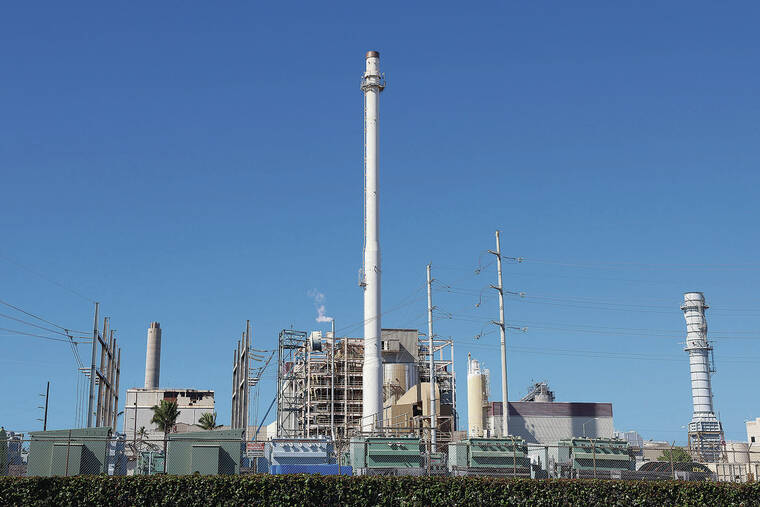
Cleanup underway for floating homeless encampments in Kalihi

MARCO GARCIA / SPECIAL TO THE STAR-ADVERTISER
People are seen in the water near the village on Monday.

MARCO GARCIA / SPECIAL TO THE STAR-ADVERTISER
Workers, above, cleared the mangroves off the embankment of Kahauiki Village on Monday in Honolulu.

MARCO GARCIA / SPECIAL TO THE STAR-ADVERTISER
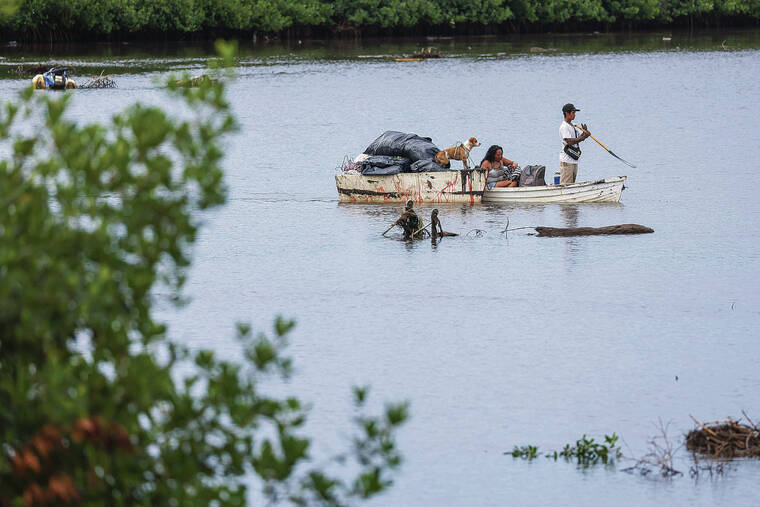
A person on a makeshift raft floated in the water where many homeless camps have woven themselves into the mangroves.

MARCO GARCIA / SPECIAL TO THE STAR-ADVERTISER
A worker in an excavator cleaned out the mangroves Monday next to a homeless camp on the embankment of Kahauiki Village.

MARCO GARCIA/SPECIAL TO THE STAR-ADVERTISER
Dogs are seen inside a homeless camp on the embankment of Kahauiki Village in Honolulu.
Heavy machinery continued Monday to tear out thick and overgrown mangroves along Keehi Stream in Kalihi that had camouflaged 25 or so floating and land-based homeless structures that have occupied the waters from Keehi Stream to Keehi Lagoon for years.
Some had their own kitchens and solar-powered electricity but no hygiene. The largest structure covered 600 square feet over two stories and floated on pontoons.
Years of outreach by the Institute for Human Services failed to clear the encampments, which hid among the mangroves and floated between city and state land during prior sweeps — although the city and state prefer the term “enforcement action.”
Then last week the city and state joined forces with nonprofit agencies and private contractors to serve notice to the homeless people living off the grid that no trespassing laws will be enforced around the Kahauiki Village community of formerly homeless families, beginning last weekend.
A 62-year-old man who lives in the flotilla with 12 dogs within eyesight of Kahauiki families did not want his name published.
But he said he will leave once the Hawaiian Humane Society takes custody of his dogs.
Don't miss out on what's happening!
Stay in touch with breaking news, as it happens, conveniently in your email inbox. It's FREE!
His neighbor has 25 dogs and also was reluctant to give up his encampment without assurances they will be cared for.
The two-story structure floated over to Keehi Lagoon last week and was demolished by state crews, said Roy Miyahira, the city’s director of homeless solutions.
One structure had a full kitchen and two refrigerators. Others were powered by generators and solar systems that provided air conditioning.
In some cases, Miyahira said, “they’re extremely impressive.”
Some of the floating shelters have been in the waters around Kahauiki Village since 2017.
“They’ve been here before I started this job,” said Castro Masaniai, who leads the Institute for Human Services’ homeless outreach teams and was working with the occupants being cleared out Monday.
Their proximity to Kahauiki Village — another joint effort by the city, state, nonprofits and builders to create a community for formerly homeless families — sends the wrong message to the parents and children living in the village who are working to reset their lives, said Connie Mitchell, executive director of IHS, which runs Kahauiki Village along with Hawaii’s largest homeless shelters.
“There’s no hygiene,” Mitchell said. “They don’t want to be part of the community and it doesn’t go with what we’re trying to do here.”
The mangroves made it hard for IHS outreach workers to even reach the occupants of the encampments to offer services, which they continued to resist even as their shelters were exposed on Monday.
The work to clear the mangroves continues to reveal the scope of the encampments both on the banks of Keehi Stream and in the water, where some have been abandoned by occupants who left behind broken and discarded items and trash, often in the water.
“There’s tons of stuff,” Miyahira said.
Mitchell and Miyahira also worry about how much human and animal feces and urine may have been dumped over the years into the waters that lead directly to the ocean.
In a statement to the Honolulu Star-Advertiser on Monday, Mayor Rick Blangiardi wrote, “This next phase reflects strong coordination between the City, State, and our nonprofit partners to address conditions along Keehi Stream in a thoughtful and responsible way. For months, outreach teams have been building relationships and connecting individuals to services and pathways toward housing. As we move forward, our focus is on safety for those in the area and for the surrounding community, while also addressing environmental concerns through the removal of vegetation and debris. Our approach remains steady, coordinated, and centered on long-term solutions for both the community and those in need.”
Ahead of a June 2024 state Department of Land and Natural Resources sweep of the state-controlled side of Keehi Stream, workers counted 55 people living in the floating shelters and on land.
During the sweep, DLNR said that several of the floating encampments simply crossed to the city side of the stream where Kahauiki Village is located.
In the meantime, Mitchell said, problems for Kahauiki Village and IHS persist.
People who live aboard the shelters in Keehi Stream have run into Nimitz Highway traffic to get to the other side and been chased by police into Kahauiki Village, which is home to over 300 children and another 200 or so adults who live in the village’s 138 units.
Kahauiki Village was born amid a flurry of new strategies that were rapidly pressed into service across Oahu when one of the country’s largest homeless encampments of over 300 people exploded in plain sight in Kakaako in the summer of 2018 after Honolulu began enforcing its controversial “sit-lie ban” in Waikiki.
Homeless people in Waikiki responded by packing up and walking down Ala Moana Boulevard to set up encampments in and around Kakaako Waterfront Park, resulting in violence, unsanitary conditions and vandalism of outdoor lighting and sprinklers systems so homeless people could access power and water.
Those living in the Kakaako encampment quickly learned to avoid sweeps by learning which streets, sidewalks and other areas were under city control and which ones, like the parks around the University of Hawaii John A. Burns School of Medicine, were under state jurisdiction to avoid Honolulu Police Department enforcement.
Rather than conducting what could have been Hawaii’s largest homeless sweep, then-Gov. David Ige and then-Mayor Kirk Caldwell worked together to create new housing aimed at specific groups, such as for motivated parents and their children, leading to Kahauiki Village.