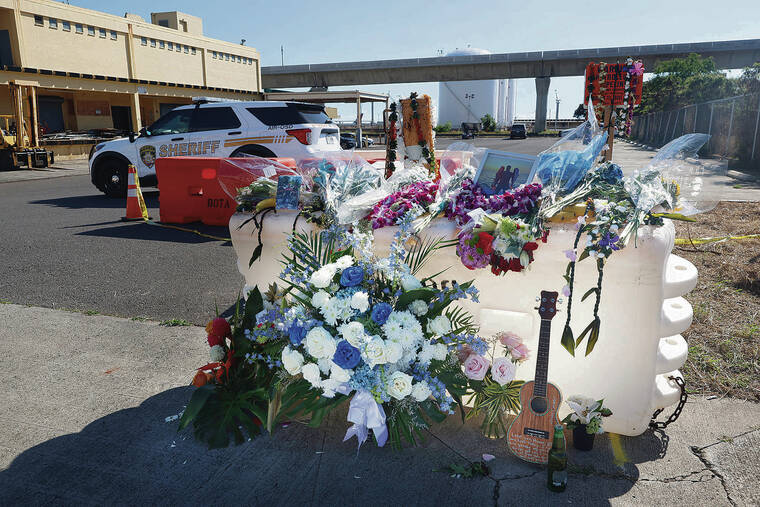
Auditor warns Hawaii legislators of initial kauhale concerns

JAMM AQUINO / FEB. 27
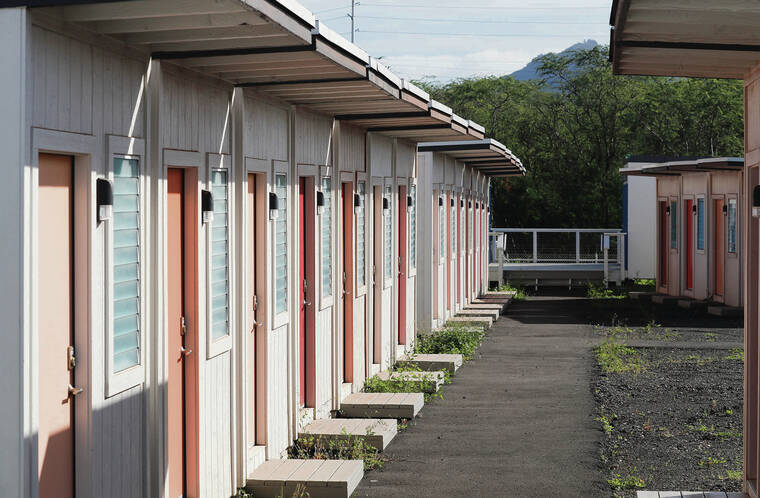
The state auditor is looking into Hawaii’s tiny home kauhale spending. The phase II area at Hookahi Leo kauhale complex was under construction in February.
State Auditor Les Kondo has sent an unusual memo to the state Legislature and the head of the state Department of Human Services warning of the need for “immediate attention” to address what Kondo called “improper use of public funds” even as his office continues to conduct an audit of Hawaii’s tiny home kauhale spending across Hawaii.
In his April 20 memo regarding his office’s preliminary work, Kondo wrote that “We are concerned that significant deficiencies in internal control in the State Office of Homelessness and Housing Solutions’ (SOHHS) implementation of the kauhale initiative create an ongoing and substantial risk of improper use of public funds.”
Gov. Josh Green launched the first kauhale in Kalaeloa as lieutenant governor and has helped expand the concept as governor to include 30 by the end of this year.
A series of executive orders — initially opposed by environmental, historic preservationists and other organizations — have accelerated the kauhale effort by clearing the path of typical government reviews and permits, while using a combination of government-owned land and labor and materials donated by HomeAid Hawai‘i — that bring the costs much lower than traditional affordable housing projects.
“Additional work, including further review of documentation and discussion with relevant parties, may result in revisions to the observations described herein,” Kondo wrote. “However, we believe it is necessary to issue this interim communication due to the immediate and continuing risk of waste and improper use of public funds.”
The audit was prompted by a bill that Green signed into law in 2025 that formalized the kauhale effort but, in the final days of the 2025 legislative session, also called for an audit.
Don't miss out on what's happening!
Stay in touch with breaking news, as it happens, conveniently in your email inbox. It's FREE!
On Tuesday, Green told the Honolulu Star-Advertiser in a text that, “this program is far bigger than feuds over receipts or emergency bids for projects …
“It’s about elderly people like Charlotte getting shelter in a tiny home and getting housing when they she faced metastatic cancer.
“Or homeless women avoiding weekly rape on the street downtown.
“Or adolescents having some safe place to go if they were locked out of their home.
“Thus how dare the auditor reduce this to a personal vendetta.
“He needs to be better.”
Green’s comments reflect previous criticisms of Kondo and his office following six months of hearings in 2021 by a special House Investigative Committee that was empanelled by then-House Speaker Scott Saiki to look into separate audits Kondo’s office conducted of the Agribusiness Development Corp. and the state Department of Land and Natural Resources’ Special Land and Development Fund.
The committee was charged with looking into the audits’ recommendations to improve “the operations and management of these state agencies, their funds, and any other matters,” Committee Chair Rep. Della Au Belatti wrote to Saiki in 2022 summarizing the committee’s findings.
But Kondo, himself, immediately became the target of the Special Investigative Committee over the course of 18 public hearings that included 22 subpoenaed witnesses and thousands of pages of documents.
During Kondo’s initial appearances before the committee hearings that began in July 2021, Belatti — an attorney — repeatedly reminded Kondo — who is also an attorney — that he had the right to retain counsel and could choose not to testify against his own interests.
Kondo rejected the recommendations, saying he was happy to discuss the audits.
Belatti was the only one of the eight committee members to question Kondo over his office’s practices themselves as the committee repeatedly failed to meet its own self-imposed deadlines. Kondo also won a Circuit Court battle over control of his office’s confidential work papers.
As the hearings dragged on, one of the eight committee members — then-Rep. Dale Kobayashi (D, Manoa-Punahou-Moiliili) — openly criticized what he called a disproportionate focus on Kondo, whose work Kobayashi said had been peer reviewed and highly rated.
In the end, the committee released its 292-page final report that found no criminal wrongdoing by Kondo but called for oversight of Kondo’s office by the Legislature through bills that have since died.
In her 2022 report to Saiki wrapping up the committee’s work, Belatti wrote that “The Committee expanded its inquiry to the Office of the Auditor after being met with ‘evasion,’ denied access to documents supporting audit findings, and informed of ‘critical omissions’ that may constitute malfeasance and noncompliance with Government Auditing Standards.”
The committee, Belatti wrote, also identified “misleading or unsupported statements” in both audits that “raised concerns about the Auditor’s professional judgment.”
Attorney Ian P. Luthringer, who represents HomeAid Hawai‘i, wrote to Kondo on Monday addressing Kondo’s preliminary kauhale audit findings that have yet to be published.
In part, Luthringer wrote that he wanted “to correct what HomeAid Hawai‘i believes are significant mischaracterizations of both HomeAid Hawai‘i’s performance and the State’s oversight of the Kauhale Initiative. If left unaddressed, your office’s current understanding and conclusions could result in an inaccurate and unfair public record, as evident from the preliminary findings already transmitted to the State Legislature.”
Kondo only told the Star-Advertiser Tuesday that, “We’re auditing the state Office of Homelessness and Housing Solutions. We are not auditing HomeAid Hawai‘i.”
While opposition and court challenges greeted Green’s initial efforts to build kauhale through emergency declarations as governor, the public has grown to support the concept as a low-cost way to get homeless people — especially those with medical, mental health or substance-abuse issues — off the street while surrounded by case management and other social service assistance.
A statewide survey of residents across the state that was released in March found that 87% support the building of tiny homes.
And even more people — 92% — said they support kauhale for “the working poor,” according to the survey by HomeAid Hawai‘i.
“The findings come amid broader housing challenges,” according to the survey.
“A 2024 Hawai‘i Housing Finance &Development Corp. planning study estimated that more than 208,000 households are experiencing housing insecurity, with approximately 27% at risk of homelessness,” according to the HomeAid Hawai‘i survey.
Hawaii needs anywhere from 50,000 to 70,000 more affordable housing units, according to varying estimates, and people who were surveyed likely believe kauhale could serve them, as well, in a financial pinch.
House Bill 431 was introduced by the House Democratic Caucus in 2025 to continue funding the kauhale initiative and to create special funds for kauhale and to help the Hawaii Housing Finance and Development Corp.
But by the time it reached Green’s desk to become law as Act 309, new language was inserted calling for an audit.
House leaders on Tuesday did not immediately respond to a request for comment on Kondo’s April 20 initial concerns.
He provided no timetable of when they should expect the final audit, but warned about initial concerns so far.
“This communication is intended to ensure that those charged with governance are informed of these preliminary observations while the audit is in progress,” Kondo wrote to them. “Based on our understanding of current practices, invoices continue to be submitted and paid with limited substantive review or verification. In our professional judgment, waiting until the issuance of a final audit report will likely result in continued exposure of public funds to unsupported or inappropriate costs. The current control environment does not provide reasonable assurance that improper billing will be detected or prevented.”