HPD chief finalist Mike Lambert vows to target gun violence

COURTESY PHOTO
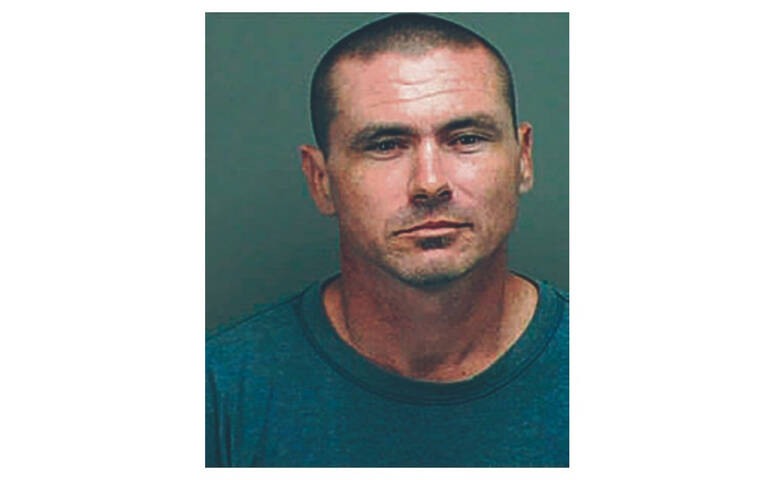
Mike Keoni Lambert
The lone local finalist vying to serve as the next chief of the Honolulu Police Department is a 22-year HPD veteran who wants to upgrade equipment and facilities, target gun violence and develop officers of every rank and role.
Mike Keoni Lambert, 46, a former HPD major who ran the Narcotics Vice Division before being named director of the state Department of Law Enforcement in January 2025, said he is the only candidate who can “truly hit the ground running.”
The son of a retired HPD lieutenant, Lambert believes he has the “institutional knowledge to fix what’s broken.” He was a finalist for chief when the Honolulu Police Commission selected Arthur “Joe” Logan for the post in May 2022. Logan retired in June and Rade Vanic has been serving as interim chief in the meantime.
When Lambert was subsequently passed over for the assistant chief’s position, he accepted the appointment as DLE director, where he oversees more than 400 employees and a budget in excess of $100 million, according to his biography posted by the commission.
“HPD doesn’t necessarily want to be something else. The officers want to get back to where they were,” he said. “There was a time … where we didn’t have the kind of issues with public trust that we have now. It’s a matter of doing what we do well, which is connect with the community and adopting the technologies that are available to us so that we can account for the current shortfalls in staffing while we rebuild the ranks.
“I’m the only candidate that is not guessing what needs to be fixed,” Lambert added. “I know exactly where (change) needs to begin. I’m going to be transparent.”
Don't miss out on what's happening!
Stay in touch with breaking news, as it happens, conveniently in your email inbox. It's FREE!
No matter who the Honolulu Police Commission selects as the city’s 13th police chief May 20, Lambert will soon leave his current post and return to HPD this summer in order to preserve his pension.
Lambert believes the department should invest in retaining officers, from patrol to command staff, by nurturing their careers. He said he understands the complexities of collective bargaining but knows that paying officers well and giving them the best benefits builds pride in the department and in serving the community.
He lauded Logan’s work to expand HPD’s recruitment team and meet many national standards. As chief, Lambert said he would continue those efforts and also focus on retention. He said he wants to provide financial incentives for officers to stay on for longer than 25 or 30 years.
The police force has “a lot of great people” at every level who have a lot of potential, according to Lambert. At the command level, he said he knows everyone’s strengths and weaknesses and would like to help them further develop their leadership qualities.
“I can look at every single commander and I know exactly what I need to help them with, what I need to hold them accountable for because of their habits, whether that’s being too nice or too aggressive. … ”
On the patrol level, HPD officers want to be treated well and fairly, according to Lambert. Most important, however, is making sure the department’s facilities and equipment are up to par, he said.
“The No. 1 thing that makes them feel special and appreciated is when their equipment is top-notch,” he said.
HPD also needs to consider expanding its fleet of vehicles by broadening the makes and models of cars that may be used as subsidized police vehicles, he said, and the recent Kona-low storms that caused catastrophic flooding underscored the need for four-wheel-drive trucks.
“That is the No. 1 thing you can do for officers: invest in their daily workplace,” Lambert emphasized. “When the water fountains don’t work and there have been plastic bags over them, and it’s been like that for a year — it’s these little things,” he said. “When you say it (praise patrol officers) and they don’t feel it, it doesn’t move the needle.”
At DLE, Lambert upgraded the bulletproof vests and firearms issued to officers there. He said HPD needs to do the same because the vests currently issued to police officers would not provide enough protection if hit with rounds from modified firearms or untraceable “ghost guns” set up to deliver automatic fire.
“I want to show these guys that if I have the ability, I’m going to get you guys the best we can afford so you guys can make it home safe to your families,” Lambert said. “At the end of the day I have to look their families in the eye.”
Lambert, who is raising a blended family of six children with his fiance, recalls how proud his own family was of his father’s HPD service.
“My dad was the perfect officer; never got suspended a day in his life. Until the day he retired, he could pass all physical standards — that kept with me,” he said. “Just because I’m a commander doesn’t mean I shouldn’t take care of myself. I should be able to do what our frontline officers are asked to do every day and if you can’t do it, it is time to hang it up.”
Gun violence is Lambert’s top law enforcement concern. He laments the proliferation of ghost guns — firearms that are put together with components purchased as a kit or as separate pieces.
“We’ve seen a cultural shift … from arguing, fist fighting to … unfortunately …using guns, printed weapons like ghost guns,” which have become increasingly easy to obtain via the web and assemble with 3D printers, he said.
While working as HPD’s Narcotics Vice Division major in 2024, Lambert tried to establish a firearms task force with the U.S. Department of Justice’s Bureau of Alcohol, Tobacco, Firearms and Explosives and the Hawaii High Intensity Drug Trafficking Area.
That effort stalled but Lambert said he carried it over to DLE and it became part of an explosives task force that focuses on illegal fireworks.
Lambert said he would fully incorporate HPD into the state’s use of the National Integrated Ballistic Information Network, an ATF program that helps law enforcement agencies connect fired cartridge casings and bullets to specific firearms, enabling investigators to link crimes across jurisdictions, according to the DOJ.
“It tells us especially when a weapon has been fired at multiple scenes … how the weapons are moving though our system. … If we start to have multiple casings with different fingerprints, we know how many people are running around slapping the trigger (of that gun),” he said.
Lambert also wants to maximize HPD participation in statewide efforts to combat child sex trafficking that are led by the state Department of the Attorney General’s Hawaii Internet Crimes Against Children Task Force.
Too many kids are being trapped, trafficked or groomed online via social media and video games, according to Lambert.
“I really do believe we need to do a better job to make sure our keiki are not being sucked up into sex trafficking,” he said. “A lot of times here in Hawaii, it’s familial … and it tears at the core of what Hawaii stands for.”
SECOND OF THREE PARTS
The Honolulu Star-Advertiser is profiling the three finalists to be Honolulu’s next police chief, to be chosen May 20 by the Honolulu Police Commission.
>> Tuesday: David S. Lazar
>> Today: Mike Lambert
>> Thursday: Scott Ebner