Oil prices surge 3% as U.S.-Iran tensions flare

REUTERS/ALEXANDER MANZYUK/FILE PHOTO
A view shows oil pump jacks outside Almetyevsk in the Republic of Tatarstan, Russia, in June 2023. Oil prices gained more than 3% today, climbing more than $3 a barrel, after comments by President Donald Trump and Iran’s foreign minister further dented hopes of a deal to end ship attacks and seizures around the Strait of Hormuz.
HOUSTON >> Oil prices gained more than 3% today, climbing more than $3 a barrel, after comments by President Donald Trump and Iran’s foreign minister further dented hopes of a deal to end ship attacks and seizures around the Strait of Hormuz.
Brent crude futures gained $3.35, or 3.17%, to $109.07 a barrel by 12:34 p.m. CDT (7:34 a.m. Hawaii time). West Texas Intermediate futures were up $3.85, or 3.81%, at $105.02.
Over the week, Brent has climbed 7.72% and WTI 10.11% on uncertainty over the shaky cease-fire in the Iran war.
“The tone between the U.S. and Iran has once again become significantly more confrontational. While the cease-fire holds, hopes for a swift reopening of the Strait of Hormuz have faded,” Commerzbank analysts said.
Iran has “no trust” in the United States and is interested in negotiating only if Washington is serious, Foreign Minister Abbas Araqchi said today, adding that Iran is prepared to go back to fighting but also prepared for diplomatic solutions.
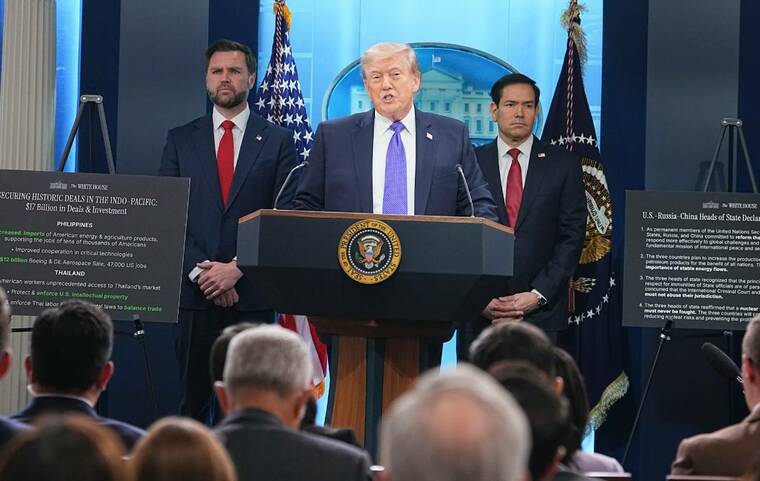
Trump said he is running out of patience with Iran and that he has agreed with Chinese President Xi Jinping that Iran cannot be allowed to have a nuclear weapon and must reopen the Strait of Hormuz. About a fifth of the world’s oil and liquefied natural gas supply normally passes through the strait, which is the gateway to the Gulf and main export route for countries such as Saudi Arabia, Iraq and Qatar.
Don't miss out on what's happening!
Stay in touch with breaking news, as it happens, conveniently in your email inbox. It's FREE!
Xi did not comment on his discussions with Trump about Iran, though China’s foreign ministry issued a statement.
“This conflict, which should never have happened, has no reason to continue,” the ministry said.
Among the deals the market was looking for from the U.S.-China summit, Trump said China wants to buy oil from the United States. Trump also said he could lift sanctions on Chinese companies that buy Iranian oil.
“Market focus is back on the deadlock and a blockaded Strait of Hormuz, with a tail risk of renewed military escalation,” said Vandana Hari, founder of oil market analysis provider Vanda Insights.
Iran’s Revolutionary Guards said that 30 vessels had crossed the strait between Wednesday evening and Thursday, still far short of the 140 a day that was typical before the war, but a substantial increase, if confirmed.
“An increasing number of vessels are filtering through the strait … although currently this has a more tangible impact on sentiment than on the actual oil balance,” PVM analyst Tamas Varga said.
The strait’s closure comes at a time when reserves are running thin.
“The world has consumed its oil safety net at a historic rate,” Phil Flynn, senior analyst with Price Group, said in a note. “While strategic releases and demand reduction have prevented immediate chaos, the margin for error is shrinking rapidly. A prolonged closure of the Strait of Hormuz points toward tighter physical markets, potential refined product shortages and upward pressure on prices in the coming weeks and months.”
Shipping analytics firm Kpler said on Thursday that 10 ships had sailed through the strait in the past 24 hours, compared with the five to seven that have crossed daily in recent weeks.
“Crude is trading higher on a combination of the Trump-Xi meeting doing little to bring us closer to a reopening of the Strait of Hormuz, and continued Ukrainian attacks on Russian refineries,” Saxo Bank analyst Ole Hansen said.