Mayor threatens budget veto if Office of Economic Revitalization is defunded
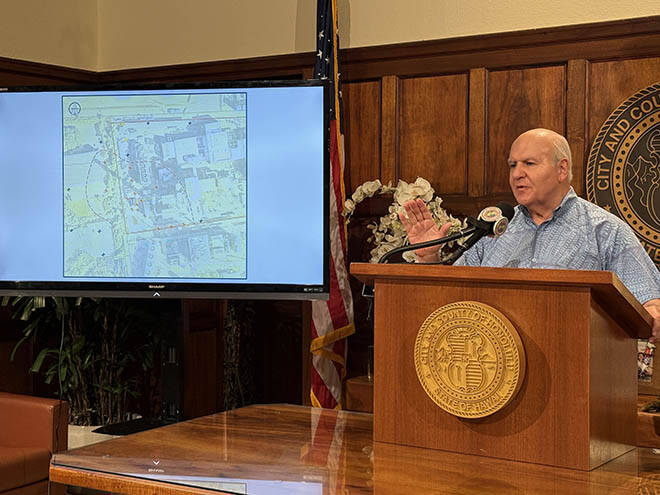
Honolulu Mayor Rick Blangiardi is threatening to veto the city’s proposed fiscal year 2027 budget if the City Council moves forward with plans to slash funding and staff for the city’s Office of Economic Revitalization.
The Council, which meets today to potentially adopt the city’s more than $5 billion budget package ahead of the July 1 start of the new fiscal year, indicates OER could lose about $1.62 million in funding and up to 20 positions.
However, the Council’s amendments in part add three “community equity liaison” positions back to OER, totaling more than $224,300, budget documents indicate.
The office, currently funded for $2.2 million and attached to the city Managing Director’s Office and staffed largely by contract employees rather than permanent civil service workers, was created in 2020, and tasked with promoting economic development and improving quality of life for residents and businesses across Oahu.
The proposed cuts to the agency follow a scathing audit released by the Office of the City Auditor in January that found OER failed to implement several economic development initiatives and lacked transparency in its budgeting and performance reporting.
In a Friday letter to Council Chair Tommy Waters, Blangiardi strongly objected to defunding OER.
Don't miss out on what's happening!
Stay in touch with breaking news, as it happens, conveniently in your email inbox. It's FREE!
“The Honolulu City Council’s proposal to incapacitate (OER) — in clear violation of the Revised Charter of the City and County of Honolulu — is deeply misguided, immensely damaging and, candidly speaking, beyond comprehension,” the mayor wrote.
“The senseless elimination of 15 of OER’s 24 positions — 13 of which are currently occupied by dedicated, hard-working public servants whose mission is to strengthen Oahu’s economy, support local businesses and help residents deal with the rising cost of living — would render our Administration unable to fulfill its Charter-prescribed responsibility to the residents of our island,” Blangiardi wrote.
The mayor stated the Council’s proposal “would dismantle programs that directly support entrepreneurs, small businesses, and economic opportunity on Oahu, at a time when revitalizing our local economy and stemming the tide of outmigration have never been more important.”
He noted those impacts could also jeopardize funding for farmers, including the elimination of a $500,000 initiative supporting 100 farmers markets across the island over the next 2 years.
Blangiardi further argued that if the Council wants to dissolve OER it should do so by voter-approval, and not via the city’s annual budgeting process.
“OER was established through the City Charter, with responsibilities specifically outlined in that Charter,” he wrote. “If the Council truly believes the office should be eliminated, then the honest and appropriate way to pursue that is through a Charter amendment where the issue can be publicly debated and considered on its own merits.”
And “If (OER) remains defunded in the budget that is ultimately passed by the City Council, I will have no choice but to veto it,” the mayor asserted.
Waters refuted the mayor’s comments.
“The Mayor has often spoken about the need for government to do more with less. That is exactly what this budget does. Given the many important investments it contains, it would be disappointing to see the entire budget vetoed over a $1.5 million reduction, approximately 0.03 percent of the Council’s proposed $4.9 billion budget,” Waters said in a statement. “Our responsibility is to focus on the bigger picture and deliver a budget that is fiscally responsible, accountable to taxpayers, and responsive to the needs of our communities.
“The Council remains committed to working with the Administration to move Honolulu forward,” Waters added.
During the May 1 Budget Committee meeting, Okimoto said the recent city audit “has made it clear that the current structure of the OER is not meeting the standards our residents deserve.
“When this office was established in 2020 it was given a clear mandate to strengthen our economy through agriculture, technology and workforce development,” she said. “Five years later the auditor finds that progress has been made on only three of its eight core responsibilities listed in the (City Charter).”
At the same meeting, area nonprofits rose to OER’s defense.
Liza Ryan Gill, with the Hawai‘i Coalition for Immigrant Rights, said OER staff aided non-English speaking survivors of the Kona-low storms earlier this year, and “started serving those populations that needed information in the language they could understand.”
Sherry Menor, the Chamber of Commerce of Hawaii’s president and CEO, backed the agency’s ongoing work with small businesses. “In a time like this, we believe that collaboration and partnerships with the government is critical and very effective in ensuring that our small business community is supported,” she said previously.
But citing the city audit, Okimoto disputed much of the public testimony to save OER.
Okimoto said OER’s inability to complete many of its core functions means the agency should be reimagined. “In any other sector, meeting less than 40% of your core mission would result in a reorganization,” she added.
“We are not gutting an office, we are performing a long overdue fiscal right-sizing,” Okimoto said. OER “is currently suffering from a textbook example of ‘mission creep.’ We are seeing a department that has shimmied through its legal mandates to become a secondary social service agency.
“It is time to prioritize performance over potential,” she said.
Meanwhile, Waters said the Council’s newly-proposed city budgets — currently totaling about $5.07 billion — reflect “a disciplined and thoughtful approach to managing taxpayer dollars.
“Through strategic reductions to historically overfunded departmental appropriations and a careful review of funding tied to long-vacant positions, the Council was able to invest in priority services while still coming in approximately $700,000 below the mayor’s initial budget proposal” of approximately $5.08 billion, Waters said in a statement. “Those additions include funding for the Department of the Prosecuting Attorney, flood-mitigation technology, road-maintenance equipment, grants-in-aid, kupuna feeding and social-support programs, Honolulu Zoo operations, homeless services, energy costs, and emergency-recovery capacity.”
The Council’s actions demonstrate “that responsible budgeting is not simply about cutting or spending more,” he added.
Today’s Council meeting is scheduled to begin at 10 a.m. inside Honolulu Hale, at 530 S. King St.