More than two decades of troubled efforts to rebuild the famed Coco Palms Resort on Kauai is on a new track for potential realization.
A Utah-based real estate investment firm that acquired the Coco Palms site in 2022 through a state court foreclosure case recently
arranged $431 million in financing and said it has begun below-grade construction work on the
32-acre property in Wailua.
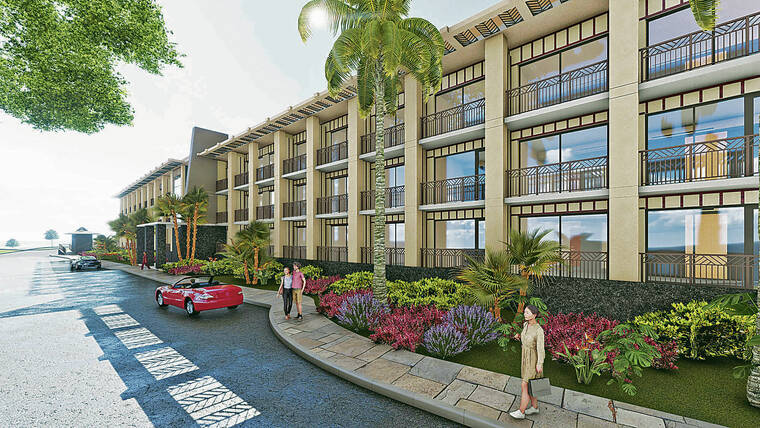
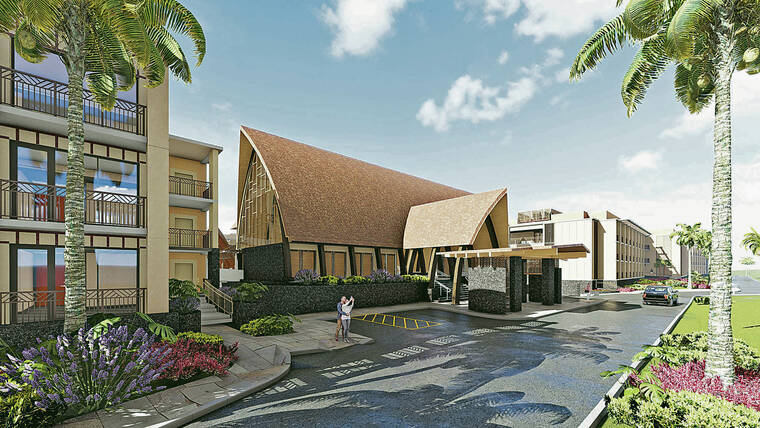
The investment firm’s plan includes restoring historic structures and creating a new 351-room hotel to be operated by management firm Highgate under the Kimpton Hotels brand with amenities including three restaurants, three swimming pools, a spa, retail, meeting space, a 300-seat cultural center to cost $539 million and open in 2028.
If the plan by Reef Capital Partners comes to fruition, it would re-establish Coco Palms 36 years after it was destroyed by Hurricane Iniki in 1992 amid a lagoon and an ancient coconut grove on a site listed on state and national registries of historic places.
Rebuilding Coco Palms also would upset a group of community members including some former and current Kauai County Council members who oppose redevelopment of the site, which contains ancient Native Hawaiian burials and was once home to Kauai’s last reigning queen, Deborah Kapule Kekaiha‘akulou.
Kauai County officials have previously said that the developer has secured necessary permits for reconstruction, and Reef representatives have said they intend to protect and celebrate an iconic place with the envisioned reconstruction of a landmark.
“Restoring this property means honoring the culture, history, and people of Kauai at every step, and we are committed to doing exactly that,” Jon Day, CFO of Reef, said in a press release announcing the financing and construction timetable.
New York-based commercial real estate lender
X-Caliber announced the $431 million financing commitment for Coco Palms reconstruction, which the company said would create 1,000 construction jobs followed by 350 full-time jobs needed to run the resort.
“Coco Palms holds a unique place in Kauai’s history, and its restoration is an exciting development for the island and its residents,” Chris Callahan, X-Caliber president and CEO, said in the announcement.
Coco Palms was established in the early 1950s as a 24-room lodge next to a former fishpond amid a coconut grove across from the ocean on the mauka side of what is now Kuhio Highway.
Expansion into a resort with more than 400 rooms, suites and bungalows took place in phases under the vision of Grace Buscher Guslander, whose husband, Honolulu hotel executive Lyle Guslander, acquired the property in 1953.
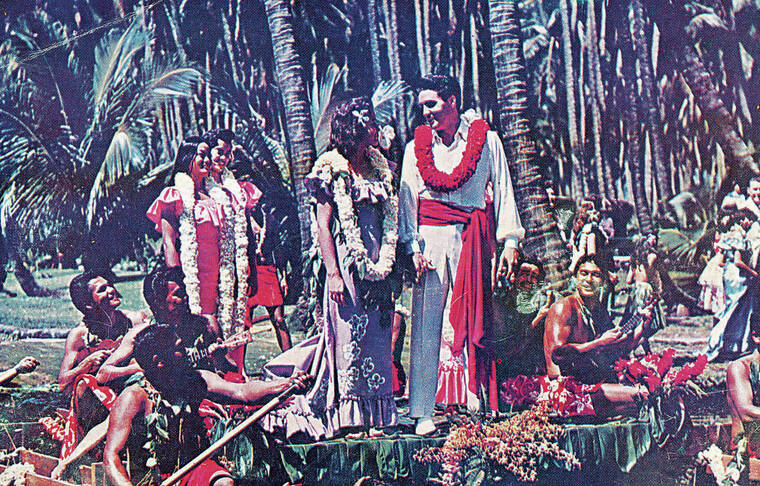
Early guests included Frank Sinatra, Bing Crosby and Elvis Presley, who starred in the 1961 movie “Blue Hawaii” featuring the Kauai resort as the site of
a wedding for Presley’s
character that boosted the popularity of Coco Palms, especially for weddings.
The 1953 film “Miss Sadie Thompson” starring Rita Hayworth also was shot on the property where producers built and left a wedding chapel.
Hurricane Iniki ended the resort’s famed existence in 1992, causing extensive damage that went unrepaired as a dispute over insurance dragged out over six years.
A few developers since then have unsuccessfully tried to restore the property, including a Maryland firm that paid $12.3 million for the site in 2006 and gave up ownership to a lender in lieu of foreclosure several years later after trouble that included an economic downturn.
In 2013, Honolulu-based developers Tyler Greene and Chad Waters announced an estimated $135 million plan to convert the property into a renewed resort managed by Hyatt, and bought the site in 2016 for $17.8 million. But their plan was derailed after delays that included regulatory approvals as well as protesters who occupied the site and filed an unsuccessful lawsuit claiming ownership.
In 2019, an affiliate of Reef that had lent Greene and Waters $22.2 million filed a foreclosure lawsuit claiming the delinquent debt had grown to $45.6 million with interest and other charges.
Reef received ownership of the property in 2022 after a court-approved foreclosure auction resulted in no one but Reef submitting a bid.
A year later, Reef demolished three main hotel buildings that had become eyesores, along with portions of an old lobby and restaurant building. One other building has yet to be demolished, and remaining structures are slated to be integrated with new
construction.
Meanwhile, a nonprofit community organization I Ola Wailuanui was formed in part to raise funds to buy the property and preserve it, but so far has not realized its plan.
The organization opposes redevelopment, claiming that the site, where Hawaiian burials were unearthed during the building and
expansion of Coco Palms, is sacred and should not be disturbed further.
“This property is incredibly sacred, and it’s been desecrated over and over again for the past 30 years,” Gary Hooser, a former Kauai County Council member and former state senator, said during a 2022 state Board of Land and Natural Resources meeting where a permit to retain use of less than an acre of state land on the Coco Palms site was
discussed.
I Ola Wailuanui has a vision to turn the Coco Palms site into a place of education, healing, culture and conservation that could include a Hawaiian culture educational center, fishpond restoration, a park, gardens, food production, a museum, musical amphitheatre and hula mound.
The organization has an online petition to support its goals that has attracted about 1,280 signatures since 2023, including one from Kaimana Poulton, who signed in May and included the message, “We cannot afford to develop our island any more, please keep
Hawaii’s land in Hawaiian hands.”
Kipp Cooley, a Kauai resident opposed to rebuilding Coco Palms, recently emailed X-Caliber leaders urging them to suspend their financial support of Reef’s plan, and suggested that the project could face litigation and delays related to community opposition.
Other I Ola Wailuanui supporters include former Kauai County Council member Mason Chock and current council members Felicia Cowden and Fern Holland.
Hooser, who lives near the Coco Palms site, said he believes the stated financing deal has unworkable contingencies and was announced to sway elections later this year for Kauai’s council and mayor that could influence a possibility of the county condemning the site.
“If anyone believes that someone’s going to give (Reef) half a billion dollars, I’ve got a bridge I want to sell,” he said. “I think it’s just hype.”
Chock, I Ola Wailuanui board vice president, said he believes that the type of financing announced, which is called Commercial Property Assessed Clean Energy and has a property tax assessment connection, would require county approval.
Chock also supports county condemnation of the site, and said the nonprofit isn’t backing down.
“We continue to be vigilant around the protection of our iwi kupuna (bones of ancestors) and cultural sites such as the fishpond on site, and stand up for the rights of the lineal descendants that are connected to these properties,” he said.