JPMorgan, Visa, Mastercard report cyberattacks on vendors
REUTERS/EDUARDO MUNOZ/FILE PHOTO
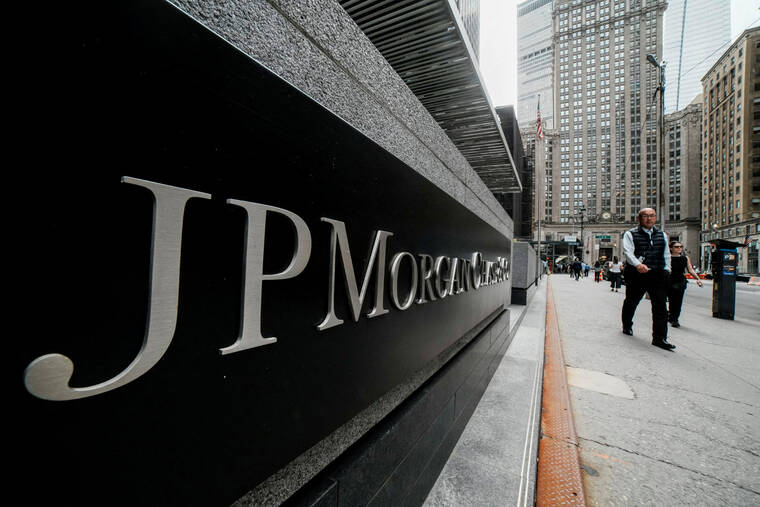
People walk near the JPMorgan Chase headquarters in New York City on April 1. JPMorgan Chase, the largest U.S. lender, said today that third parties who provide services to the firm were the target of a cyberattack.
JPMorgan Chase, the largest U.S. lender, said today that third parties who provide services to the firm were the target of a cyberattack.
“Based on our investigation so far, we believe the attackers accessed certain marketing data held by those vendors, which may include some customer names and email addresses,” a JPMorgan spokesperson said, adding that the company would be contacting the affected customers directly.
“There is no connection to service disruption of some customers experienced earlier this week,” the spokesperson added.
Earlier this week, the bank experienced problems processing transactions due to a software bug which also affected other banks and caused some disruptions.
These incidents at JPMorgan followed several other recent problems, including a nationwide FAA ground stop that disrupted travel last week and Microsoft’s global email outage, while last month crypto exchange Binance experienced a massive hack.
After the outage, lenders received inquiries from the Office of the Comptroller of the Currency, according to an industry executive, who added that the U.S. banking regulator was trying to assess the impact and wanted to know about communication to customers.
Don't miss out on what's happening!
Stay in touch with breaking news, as it happens, conveniently in your email inbox. It's FREE!
The Treasury and the OCC were calling banks minutes after the incident was reported to check that the issue was contained and it was not a cyber-related incident, a second person said adding that the OCC routinely checks after any such incidents.
“Customers don’t distinguish between a bank and a vendor when it comes to a cyberattack, so there is a question of reputational risk here,” said Carissa Robb at SolomonEdwards, a consulting firm. “There needs to be a little bit more pressure on how often companies are scrutinizing the amount of data that is shared with vendors and the necessity of the data being shared,” Robb said.
A cyber extortion group called “n0n” claimed on November 16 to have obtained cardmember engagement records that included “hundreds of thousands of campaign interactions for tens of thousands of distinct cardmember email addresses,” according to a screenshot of the message captured by cybercrime research platform eCrime.ch.
The data includes what appears to be 124 bank employee email addresses and more than 16,000 customer email addresses, some with phone numbers and postal codes, according to a Reuters review. Reuters could not independently verify the authenticity of the data.
JPMorgan declined to comment on the data.
The same hacking group on November 16 posted similar claims regarding Visa and Mastercard and posted data.
A Visa spokesperson said the company is aware of the claims and that they are “associated with an incident involving a third-party service provider in Asia Pacific. Visa’s systems were not involved and were not impacted. No payments data such as card numbers were affected.”
A Mastercard spokesperson said the company was recently informed of an incident “at a third-party provider that resulted in the exposure of limited amount of email addresses — non-payments information — from a small subset of cardholders enrolled in a specific benefit program. There is no impact to the Mastercard payment network or the ability for people to use their cards.”
The Visa data posted by the group appears to be primarily focused on Asian-Pacific markets, including Hong Kong, Taiwan, Korea, Japan, Philippines, Singapore, Malaysia, Australia, Macau and others, according to a Reuters review. Across several spreadsheets, the data includes thousands of purported customer email addresses, phone numbers, and Visa marketing campaign data. Reuters has not verified the authenticity of the data.
The Mastercard data posted by n0n includes marketing data related to customers in North America, the Middle East and Africa, and a small number of Mastercard employee email addresses.
The hacking group has claimed roughly 200 incidents since emerging in September 2026, according to eCrime.ch.