Hawaii must ‘harden infrastructure’ against natural disasters, Rep. Tokuda says
BRUCE OMORI / SPECIAL TO THE STAR-ADVERTISER
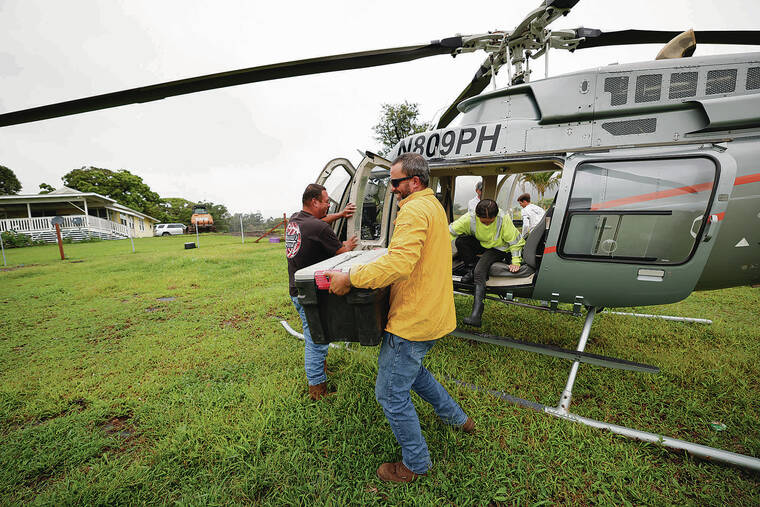
Kuali‘i Camara, center, and Lori Walker, right, of the Office of Hawaiian Affairs, and helicopter company Vertical Worx deliver food and supplies Monday to Kirk Derasin, left, and his ohana on Ka‘alaiki Road, near Wood Valley, mauka of Naalehu and Pahala, as two washed-out bridges and landslides cut off access to the area following Hurricane Lala.
RONIT FAHL / SPECIAL TO THE STAR-ADVERTISER
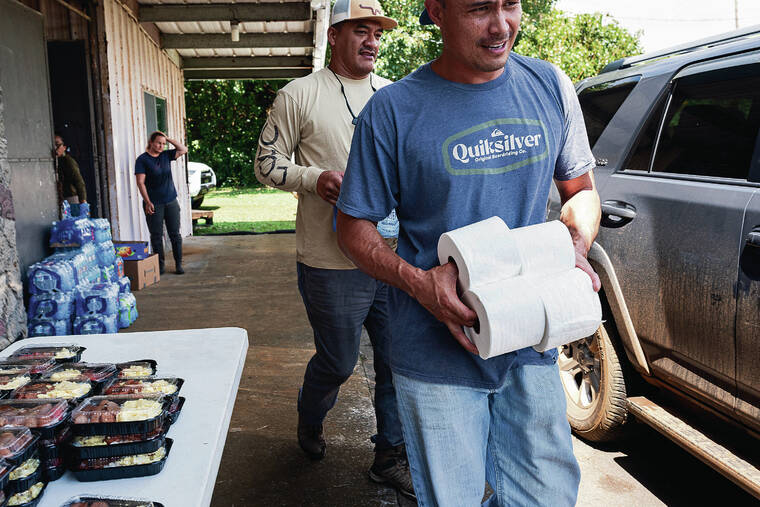
Volunteers hand out essential supplies and meals Tuesday at Vibrant Hawai‘i’s Naalehu Resilience Hub based at the Naalehu Howanji.
U.S. Rep. Jill Tokuda said Wednesday that the destruction in Kau after Hurricane Lala underscores the need for Hawaii to rethink how it prepares for, responds to and recovers from natural disasters.
Tokuda spent Monday and Tuesday on Hawaii island, traveling by road to Naalehu Elementary School and later viewing the damage from the air. She said the school was among the hardest-hit facilities she has seen in recent disasters, including the Kona-low storms and earthquakes.
Roads and bridges leading to Naalehu were covered with debris, with some sections difficult or impossible to pass, Tokuda said. At the school, flooding and debris caused extensive damage, including portable buildings being pushed off their foundations and water remaining on campus.
“The amount of damage at that particular school was significant,” Tokuda said.
Debris scattered across the school grounds showed the force of the floodwaters, she said. Dryers, freezers, refrigerators and other household items had been carried from nearby homes onto the campus.
“The nearest home was probably a football field away,” Tokuda said, describing the force of the water that swept through homes and carried personal belongings across the area.
Don't miss out on what's happening!
Stay in touch with breaking news, as it happens, conveniently in your email inbox. It's FREE!
Tokuda was unable to reach damaged homes on the ground but said aerial views showed widespread mud and flooding, as well as damage to homes, businesses and public spaces.
Tokuda said Hurricane Lala, following the Kona-low storms, Maui wildfires and other disasters, should prompt a broader reassessment of Hawaii’s approach to disaster recovery.
She said rebuilding infrastructure exactly as it was before a disaster may not always make sense, particularly as communities face rising sea levels, flooding and erosion.
“We have to be smarter. We have to harden our infrastructure,” Tokuda said. “It’s penny-wise, pound-foolish … to think that we’ll just repair the way it was and we’ll be fine.”
That could mean reassessing where roads and other critical infrastructure are located, examining water flows and erosion and determining whether some infrastructure should be relocated rather than rebuilt in the same vulnerable areas, she said.
Meantime, forecasters are monitoring another storm system developing behind Lala in the Central Pacific. Investigation area 90E has a 90% chance of developing into a tropical depression or tropical storm over the next seven days, according to forecasters. Forecast models show the system could pass near the Hawaiian Islands, but its exact track remains uncertain.
While Lala did not make landfall on Hawaii island, it still left behind a trail of devastation.
Tokuda credits state and county road crews and contractors for clearing debris quickly. Roads that were difficult to navigate Monday looked dramatically different the following day, she said, allowing emergency vehicles and supplies to begin reaching heavily affected communities.
The body of a man in his 60s whose identity has not been released was found Tuesday in a Naalehu pasture, marking the second fatality police believe is linked to Hurricane Lala.
The Hawaii Police Department said the man’s body was found around 2:50 p.m. in a pasture off Highway 11 near the 63-mile marker. Police had been asked Monday to conduct a welfare check on a missing person in Kau but were unable to locate him.
The first confirmed death was 93-year-old May Doi of Naalehu, who was found dead after being reported missing during Lala’s heavy rain and strong winds Saturday. Police also believe her death was related to the hurricane.
Autopsies are planned to determine the exact causes of death. Foul play is not suspected in either case, police said.
Significant infrastructure damage continued to hamper recovery Wednesday, with Hawaiian Electric crews working to restore power to about 17,570 customers statewide, the majority on Hawaii Island.
Tokuda said her office is working on a letter urging the U.S. Department of Agriculture to approve disaster Supplemental Nutrition Assistance Program benefits, which could provide additional food assistance and ease eligibility requirements for people affected by the storm.
Tokuda also said her office is working with the state Department of Education and the Federal Emergency Management Agency over food spoiled when schools lost electricity. Even schools that were not flooded may have suffered significant losses because food in their kitchens could no longer be used.
DOE expects insurance and FEMA assistance to help recoup those losses, Tokuda said. The department did not respond to inquiries from the Honolulu Star-Advertiser.
Farmers and ranchers also could benefit from recent changes to the Emergency Conservation Program, which allows up to 75% of eligible cost-share assistance to be provided up front for expenses such as debris removal, equipment replacement and seed.
Tokuda said the change is especially important for rural communities and small businesses that may not have enough cash to cover recovery expenses up front and wait for reimbursement. The goal is to help farmers and ranchers begin repairs and cleanup sooner without taking on additional debt or financial risk.
The challenges remain especially acute in remote parts of Kau, where damaged roads, bridges, waterways and landslides have restricted access.
The Office of Hawaiian Affairs and its partners used helicopters Tuesday to deliver about 1,500 pounds of emergency supplies to four isolated communities: Wood Valley, Kalaiki/Makanau, Lower Moaula and Haao Springs.
The deliveries included 25 cases of drinking water, food, rice, cooking supplies, hygiene and healthcare products, diapers, batteries, fuel and cleaning supplies.
OHA Hawaii island staff and Vertical Worx — a Hawaii-based helicopter operator specializing in remote and hard-to-reach areas — surveyed the area Monday to identify heavily damaged communities with limited access to aid. The next day, OHA used emergency funds to purchase supplies and arrange helicopter deliveries.
In Wood Valley, the helicopter also transported a person with specialized equipment intended to help clear internal roads and improve access within the isolated community.
Aerial observations during the operation showed extensive damage across Kau, including new channels carved into hillsides by rushing water, damaged or destroyed roads and widespread rock, tree and other debris. Some homes and properties also sustained severe damage.
OHA said current needs in the isolated communities include generator fuel, electricity and generators, drinking water and household supplies. The agency will continue assessing longer-term needs as roads and infrastructure are restored.