Fatal 2024 plane crash in Honolulu due to maintenance failures, NTSB report says
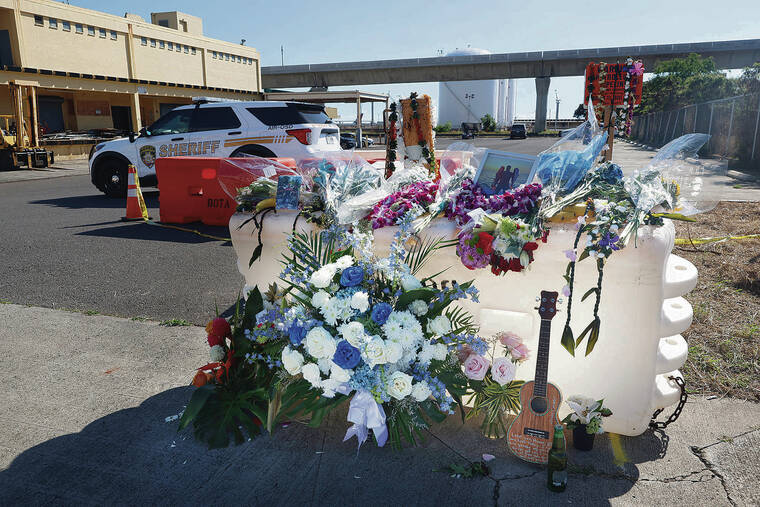
GEORGE F. LEE / GLEE@STARADVERTISER.COM
The makeshift memorial on Thursday, Dec. 19, 2024, for the two victims of the Dec. 17 Kamaka Air crash on Ualena street.
A Dec. 16, 2024, Kamaka Air plane crash that killed two young pilots near the Daniel K. Inouye Airport was the result of poor maintenance and the “operator’s failure to follow” its Federal Aviation Administration approved maintenance program and inadequate “training and supervision” of its mechanics, according to the National Transportation Safety Board.
The in-flight failure of the “flap system’s left interconnect rod due to preload from improper maintenance … resulted in an asymmetrical flap condition and an uncommanded left roll at an insufficient altitude for recovery,” the NTSB’s Aviation Investigation Final Report found.
“Contributing to the accident was the operator’s failure to follow its FAA-approved maintenance program and inadequate training and supervision of its mechanics,” according to the NTSB.
Hiram Solomon Kano‘a deFries-Saronitman, 24, and Preston Kaluhiwa, 26, of Kaneohe, died after the single-engine Cessna 208 they were flying crashed into an abandoned building and exploded. The single-engine Cessna 208 was headed to Lanai Airport.
Hiram’s mom, Tamar deFries, told the Honolulu Star-Advertiser that her son had such “a loving soul.”
“He brought people together and was always looking out for someone else. We miss his laugh, those dimples, and his hugs. He gave the best hugs,” she said Friday. “People still stop us to tell us how Hiram took care of them. We’re grateful for every story. Hiram made the people around him better, and we want to carry that love forward in how we care for others.”
Don't miss out on what's happening!
Stay in touch with breaking news, as it happens, conveniently in your email inbox. It's FREE!
On Dec. 16, 2024, Kaluhiwa, the flight instructor, seated in the left seat, and the pilot receiving instruction, deFries-Saronitman, seated in the right seat, departed on an instructional flight as part of the operator’s second-in-command training program.
During initial climb after takeoff, the airplane began a “shallow turn to the left, and the tower controller queried the pilots because he had instructed them to fly the runway heading then turn right,” according to the NTSB’s findings.
The flight instructor responded, “We are out of control here.” The airplane reached a maximum altitude of about 350 ft above ground level before surveillance video footage showed the aircraft’s left turn steepened, and the “airplane descended and impacted an abandoned building.”
A post-crash fire consumed much of the wreckage but examination of the engine revealed “no evidence of mechanical malfunction or failure that would have precluded normal engine operation, and the damage signatures were consistent with the engine developing power at the time of impact.”
A video study performed on a recording that captured the final seconds of the flight determined that the airplane’s “flap positions before impact were consistent with the right flap extended 20 (degrees) and the left flap extended about 5 (degrees),”according to the NTSB.
“Post accident examination of the flap system revealed that the flap actuator jack screw was found extended in a position that corresponded with a 20° flap setting. The portions of the right and left flap cables that extended from each inboard aft bellcrank to the outboard end of each respective flap exhibited worn and fractured wires (cable strands) about 79 inches from their respective attach points on the bell cranks. These wear damage locations were consistent with the cables having made rubbing contact with the flap cable pass through cutouts in the structure of each wing,” investigators found.
The airplane’s maintenance records indicated that the most-recent scheduled inspection of the flap system was performed “about 6 months (about 574 airplane operating hours) before the accident.”
About 10 weeks before the accident, the “operator replaced the primary flap motor after a pilot reported that the flaps failed to retract after landing.”
A review of the operator’s maintenance records for all Cessna 208 series airplanes in its fleet showed that, “between 2013 and 2024, the operator performed replacements of only the primary flap motor on several airplanes and the entire flap actuator assembly on others”.
Post-accident interviews with the company maintenance managers and personnel revealed that “there was no formal training for maintenance personnel and that mechanics learned on the job by shadowing other mechanics.”
Interviews with company maintenance personnel and post accident reviews of the operator’s maintenance records indicated a “lack of understanding of and compliance with the AMM and the record keeping provisions” of the operator’s FAA approved maintenance program.
A review of FAA records for oversight of the operator revealed “turnover in several of the operator’s key management positions” in the 3 years before the accident and in the FAA personnel assigned to oversee the operator’s maintenance program.
“About 2 to 3 months before the accident, FAA personnel identified deficiencies with the operator’s maintenance record keeping and began working with the operator to correct those issues. At the time of the accident, the operator’s work to address these deficiencies was ongoing,” according to the NTSB investigation.
After the two young men died, the operator “checked the flap travel and flap cable tension in the remaining Cessna 208 series airplanes in its fleet and corrected all identified discrepancies.”
“The FAA also initiated an in-depth inspection of the operator that intended, in part, to identify hazards and assess and mitigate associated risks. The inspection again identified maintenance record keeping issues among the items to be corrected. As of June 2026, some actions were completed and others were ongoing,” according to the NTSB.
Tamar deFries said that NTSB report “can’t bring Hiram back.”
“No parent should have to bury a child. We have an obligation as a community to make this industry better so that no family ever in a million years has to endure this kind of pain,” she said.