HART approves $652M budget amid delay warnings
GEORGE F. LEE / GLEE@STARADVERTISER.COM
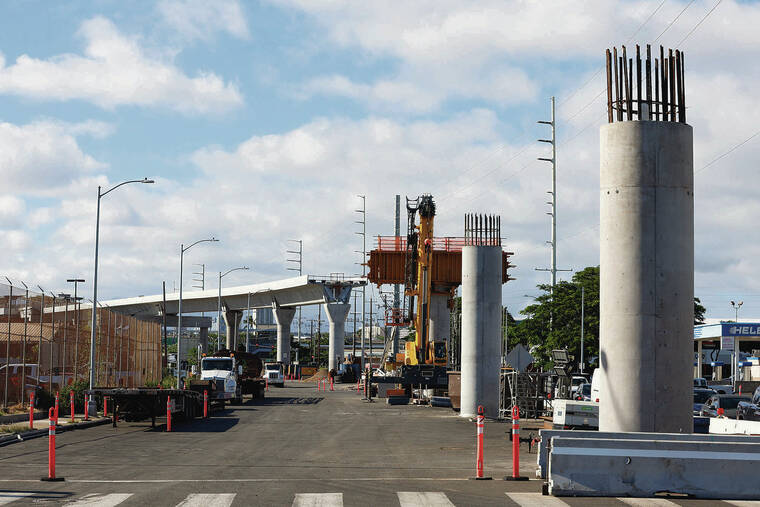
Skyline construction continued along Dillingham Boulevard last week. A risk assessment from the Federal Transit Administration’s Project Management Oversight Contractor projects completion of segment 3 will be pushed back to May 2032.
The Honolulu Authority for Rapid Transportation’s Finance Committee on Friday approved a proposed $651.8 million spending plan for the next fiscal year as federal transit overseers warn mounting construction delays could push completion of Skyline’s third segment beyond its scheduled 2031 opening well into the following year.
Segment 3 will add six stations between Middle Street and the Civic Center, completing Skyline’s current 18.9-mile alignment from East Kapolei to downtown Honolulu.
In its monthly report covering August, the Federal Transit Administration’s Project Management Oversight Contractor, or PMOC, cited problems involving Hawaiian Electric Co. infrastructure, slower-than-planned construction and coordination among contractors building the final segment to Kakaako.
Although HART continues to target March 31, 2031, for full revenue service, the PMOC considers that schedule unlikely. Its risk assessment instead projects a May 2032 opening — about 14 months beyond the agency’s target.
“It is quite alarming,” HART Executive Director and CEO Lori Kahikina told the board’s Project Oversight Committee Friday.
HART Director of Project Controls Corey Ellis also expressed concern over future rail delays to Kakaako. “It’s getting difficult to not foresee impacts at this point,” he said.
Don't miss out on what's happening!
Stay in touch with breaking news, as it happens, conveniently in your email inbox. It's FREE!
Kahikina said HART would bring the matter to the board and FTA once the agency has “a more concrete date.”
“We’re sharing what information we have now; it’s definitely showing a delay,” she added. “We don’t know how much we can actually recover from this delay.”
Board Chair Kika Bukoski asked when staff would to able to brief the board on the potential impact to Segment 3’s completion. Kahikina said that review would likely occur early next year.
Still, the PMOC warned that the city’s rail delays involving major construction and utility relocation contracts could consume most of the project’s remaining schedule contingency.
To that end, City Center Utility Relocation contracts CCUR IV and CCUR IV-E have encountered problems installing and replacing Hawaiian Electric’s 138-kilovolt infrastructure, the report indicates. Improperly installed conduits have required replacement, while excessive cable tension and electrical pole foundation problems have further delayed the work.
The utility work is critical to the City Center Guideway and Stations, or CCGS, contract, which covers the final 3-mile segment from Middle Street in Kalihi to the Civic Center station. Delays in accepting replacement infrastructure could affect other construction, the PMOC said.
The report also cited slow progress by Los Angeles-based Tutor Perini Corp., which received a $1.66 billion contract in 2024 to build the final segment and its six stations.
Tutor Perini’s schedule called for completing about one guideway shaft every five days, but production had reached only one every 10 days. The contractor planned to add another drilling rig, although HART needed to ensure the work would not conflict with utility relocation.
As of July 31, 27 of the 148 required guideway shafts had been installed, including three in July. Fourteen guideway columns also were completed.
The PMOC also cited delays in designing the segment’s core systems. HART issued train contractor Hitachi Rail Honolulu a notice to proceed at the end of 2024, but design work did not begin until the second quarter of 2026.
That delay could complicate coordination because Tutor Perini must incorporate systems designs into its guideway and station construction plans.
The report also questioned whether West Oahu transportation improvements would be completed for the rail extension’s opening. Specifically, the scope and schedule for the $254.6 million Pearl Highlands Transit Center and H-2 access ramp remain uncertain. The PMOC warned that the transit center and ramp might not be ready in time.
HART is working with state and city transportation officials to finalize designs and schedules, the report indicates.
Despite the concerns, overall project progress was about 71% complete as of July 31, matching the late-plan target. Construction was more than 68% complete, compared with a target of 66.5%, the report states.
Meanwhile, approval of the fiscal year 2028 budget includes $182.5 million in operating expenses and $469.3 million in capital spending.
The total is about $417 million, or 39% below the current fiscal year’s $1.07 billion budget. The decrease is largely due to lower projected capital spending, including a reduction in the CCGS project allocation from $550 million to $119.2 million.
HART projects about $1.75 billion in total funding, including an unreserved fund balance of approximately $813 million.
Under the City Charter, HART must submit its annual proposed budgets to the Honolulu City Council through the Mayor’s Office by Dec. 1.
Final action on HART’s next budget is anticipated before June 30 .