Lawmakers plan hearing on delayed disclosure of H-POWER diesel spill

GEORGE F. LEE / GLEE@STARADVERTISER.COM
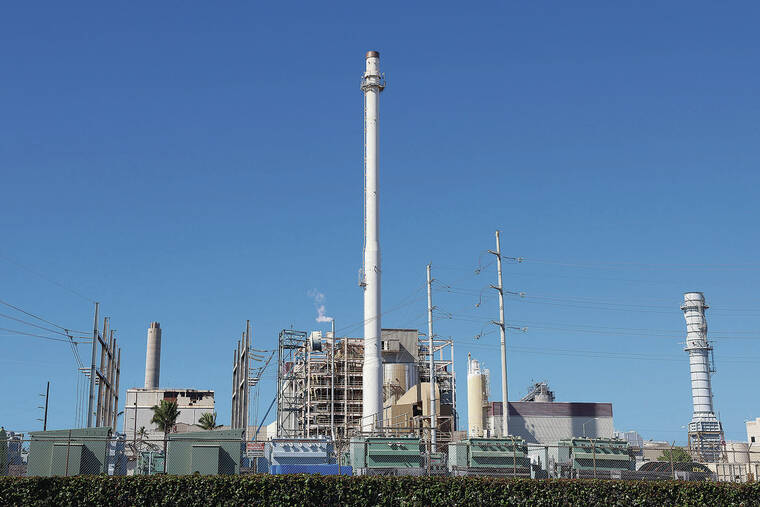
The H-POWER plant in Campbell Industrial Park in Kapolei was the site of a massive fuel spill on Thursday. The facility is operated by Reworld under an annual $60 million contract.
State legislators plan to hold a hearing next month to understand how more than 400,000 gallons of leaked diesel fuel spilled underneath Campbell Industrial Park’s H-POWER plant for months and then wasn’t announced to the public until Thursday.
The hearing would come ahead of likely legislation that could determine the future of H-POWER in Hawaii. The city-owned garbage-to-energy plant is operated by Reworld under an annual $60 million contract with the city’s Department of Environmental Services.
News of the delay in reporting the spill was particularly alarming to state Sen. Chris Lee, who chairs the Senate’s Water, Land, Culture and the Arts Committee, especially following the major fuel leak in 2021 from the Navy’s underground storage facility at Red Hill that has yet to be fully cleaned up before its planned decommissioning in 2028.
“We’ve known H-POWER (contractor Reworld) has had a terrible contract with the city for years that’s essentially held the local community hostage, leading to higher fees and costs and outdated technology and has basically blocked new, modern technologies and other companies from coming into the space with better options that are now being used in cities and countries all around the world,” said Lee (D, Kailua-Waimanalo-Hawaii Kai).
H-POWER burns city trash and converts it into electricity, and Lee noted the city has to “write a check” if its deliveries of trash fall short.
“It comes at a time when the technology is way outdated,” he said. “It really stands out as one of these relics that most other places have completely done away with and moved away from.”
Don't miss out on what's happening!
Stay in touch with breaking news, as it happens, conveniently in your email inbox. It's FREE!
If the city asks the Legislature for funding or other assistance to help deal with the H-POWER spill and its aftermath, Lee said the state could be in a position to set terms to deal with H-POWER’s future, including possible closure or transition to a different contractor.
At stake is the future of a new Oahu landfill, which no community wants, to replace the Waimanalo Gulch Sanitary Landfill in Kapolei that’s also scheduled for closure in 2028.
State Rep. Darius Kila (D, Nanakuli-Maili) has been urging the city to close Waimanalo Gulch and find a new landfill site away from the Leeward Coast.
“Our framework for reducing our (trash) footprint has to be looked at from the lens of what other island nations are doing, like Hong Kong and Japan. They are doing amazing things,” Kila said. “We’re a First World country but we are behind the curve of technology as it relates to waste reduction and waste disposal technology.”
Honolulu Mayor Rick Blangiardi said he was not informed about the H-POWER leak until Tuesday, and that he called Gov. Josh Green, who is on the mainland, on Wednesday to inform him. Green was still traveling Friday and his office said he was unavailable to provide his reaction to the news.
“I find this completely unacceptable. It’s not how we operate,” Blangiardi said Thursday.
Lee and other state legislators want to know more about who knew how severe the leak was, when they knew about it and why it was not reported to the public earlier.
Timeline of events
According to a timeline of events provided to the Honolulu Star-Advertiser on Friday by state Department of Health Director Kenny Fink, DOH’s Hazard Evaluation and Emergency Response on-scene coordinator was first notified May 4 of a suspected 6,500-gallon leak at H-POWER due to “a change in fuel level at the tanks as well as staining and odor around the piping between the tanks and the boiler house.”
The volume of the leak, Fink said in his statement, was “over the 25-gallon reporting threshold and triggered the state’s environmental response law.”
H-POWER’s staff and operator worked to identify the source of the leak, Fink said, and provided the Health Department with an “Emergency Response Work Plan” on May 9.
On May 11, a new above-ground piping system was installed and fuel activities resumed that day.
But a Health Department inspection May 27 found signs of “a new diesel release,” according to Fink.
Soil sampling and other fuel recovery activities continued throughout June and July, he said.
Then on July 9, Health Department officials were told by Reworld that the size of the spill was actually between 200,000 and 400,000 gallons, Fink said, prompting DOH to require weekly updates and groundwater monitoring.
“This did not trigger additional notifications because the tanks are 4.5 miles downslope of the nearest drinking water well, and the depth to groundwater is 7-feet below ground surface, half-a-mile from the ocean,” Fink wrote.
The Environmental Protection Agency said that state officials “did not engage EPA on this matter until August 21, 2026.” Since then, it said it’s been assisting the Health Department “and we remain prepared to support HDOH however they need.”
Blangiardi on Thursday said he was not told about the spill until late October and only learned about its scope this week. An investigation is underway to determine why there was a “major breakdown in communication,” he said.
State House Speaker Nadine Nakamura agreed that lawmakers need a clearer picture from the parties involved of how the leak occurred and the subsequent actions taken to respond to the situation and keep the public informed.
“The 400,000-gallon fuel leak raises serious concerns about its impacts on public health and the environment, and the public should have been notified sooner,” she wrote in a statement to the Star-Advertiser.
“The Legislature will hold an informational briefing with the appropriate regulators and the contractor that operates H-POWER to understand what happened, what remediation is necessary, and what steps must be taken to ensure timely public notification and prevent a similar incident from happening again. We will also determine whether additional oversight or changes to state law are warranted.”
Unlike the Red Hill fuel leak that contaminated the underground drinking water supply for half of Oahu, Honolulu Board of Water Supply Chief Engineer Ernie Lau stressed that the H-POWER leak was not a threat to Oahu’s water at Thursday’s news conference.
State Sen. Carol Fukunaga, who chairs the Senate’s Public Safety, Resiliency, and Military Affairs Committee, joined fellow lawmakers in calling for an inquiry.
“The reported release of more than 400,000 gallons of fuel at H-POWER raises serious concerns about public safety, environmental protection, and the timeliness of public notification,” she said in a statement.
“It is important that the circumstances surrounding this incident are thoroughly examined, that appropriate safeguards are in place to prevent similar incidents, and that the responsible agencies provide timely, accurate, and transparent information to the public.”