Unknown consequences fuel debate over deep-sea mining in Pacific waters

STAR-ADVERTISER / MAY 12
Jeffrey Drazen, who runs the Deep Sea Fish Ecology Lab at University of Hawaii at Manoa, has studied the impact of deep-sea mining sediment plumes on mid-level water ecosystems, which is where 90% of the ocean’s organisms live. Drazen examines a preserved lancet fish.
CHLOE JONES / CJONES@STAR-ADVERTISER.COM
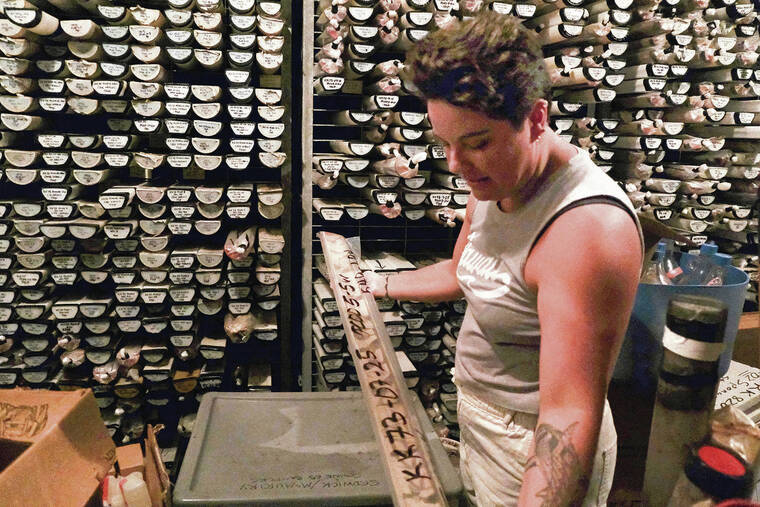
Marine paleoecologist and early career research fellow Sara Kahanamoku pulled deep-sea sediment cores from a lab at the University of Hawaii at Manoa in May. Sediment cores, which pull a fossilized record of the deep sea, can show long-term climate patterns and other geological information.
COURTESY NOAA OCEAN EXPLORATION
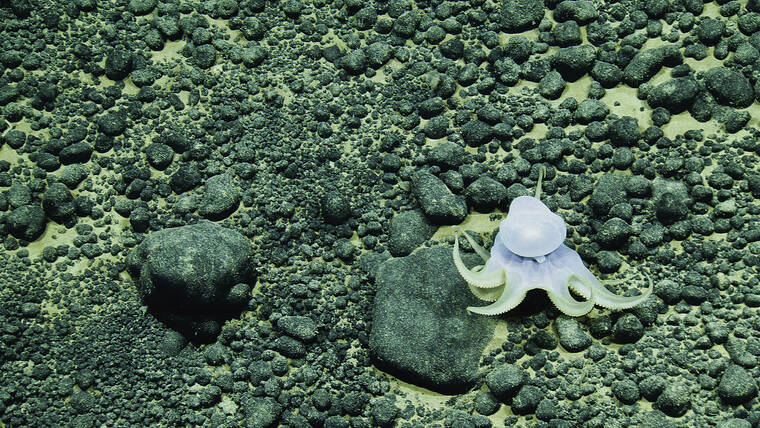
This Casper octopod was photographed at a depth of over 2.5 miles in a polymetallic nodulerich area in the waters of the Cook Islands. Nicknamed “Casper” when it was first seen in 2016 during an expedition on Okeanos Explorer, this popular octopod remains undescribed.
COURTESY NOAA OCEAN EXPLORATION
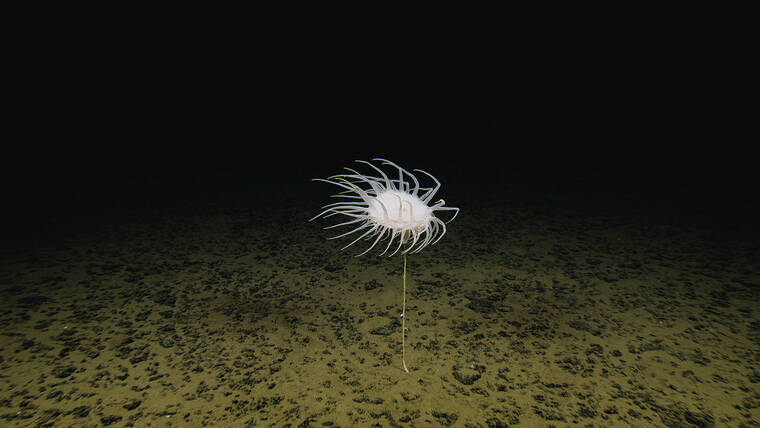
On the deep seafloor of the Cook Islands, a predatory anemone established itself on a seafloor blanketed with small, spherical manganese nodules by wrapping around a sponge stalk anchored to a nodule.
Environmental concerns over deep-sea mining mostly boil down to one issue: No one knows what goes on down there.
Companies seeking minerals for batteries and other technologies are racing to develop deep-sea mining operations targeting polymetallic nodules — potato-sized rocks rich in nickel, cobalt, copper and manganese. Supporters say harvesting the nodules could help meet rising demand for materials used in electric vehicles and renewable-energy systems, and may have fewer environmental and social impacts than expanding some land-based mining.
Scientists caution that because so little of the deep ocean has been explored, the environmental consequences remain largely unknown. They warn that impacts could extend far beyond mining sites through ocean currents, migratory fish populations and interconnected food webs.
Species harvested commercially and for recreation in Hawaii travel vast stretches of the Pacific, raising concerns that ecosystem disruptions could spread well beyond extraction zones.
That debate carries particular significance for Hawaii as several proposed mining areas lie in Pacific waters connected to fisheries and ocean ecosystems that island communities depend on for food security, cultural practices and economic activity.
The National Oceanic and Atmospheric Administration has acknowledged that deep-sea mining is understudied, writing in a January 2025 fact sheet that the impacts from mining the seafloor — and whether it could affect essential functions of the ocean’s ecosystem, such as oxygen, carbon and nutrient cycling — “have yet to be determined.”
Don't miss out on what's happening!
Stay in touch with breaking news, as it happens, conveniently in your email inbox. It's FREE!
But NOAA refused to answer specific questions about the environmental impacts of deep-sea mining.
Biodiversity at risk
The deep sea is far more diverse than many people realize, according to Lisa Levin, a professor at the University of California San Diego’s Scripps Institution of Oceanography. Like life on land, it contains a range of habitats, including mountains, valleys, canyons and plains.
“Every expedition to a new place (in the deep sea) discovers new species,” Levin said.
The deep sea is home to organisms that live for centuries, she explained. Large corals can be up to 4,000 years old, and the oldest known species, a glass sponge, is estimated to be around 18,000 years old.
Mining the deep sea could destroy new species before they are discovered and disrupt important ocean functions, Levin said.
Sara Kahanamoku, a marine paleoecologist and early career research fellow at the University of Hawaii Manoa, shares Levin’s concerns.
During an April 2025 research cruise, scientists documented at least 53 new species across 16 dives, Kahanamoku said. One discovery occurred when researchers transferring a jellyfish to a sample vial realized it had been feeding on coral, revealing a behavior previously unknown to science.
The jellyfish essentially got seasick from the 15-foot swells, Kahanamoku said, causing it to expel its stomach contents to reveal the discovery.
“We were dying,” Kahanamoku recalled with a laugh. “We just made a jellyfish barf. … Then the curators of the Smithsonian the next day were like, ‘Thank you so much — that’s actually exactly what we needed to describe this new class of organism.’”
Deep-sea mining could put discoveries like that jellyfish at risk, according to Kahanamoku. The sediment plumes caused by mining the seafloor could suffocate organisms and species. Unlike land-based mining that digs deep into the earth’s surface, Kahanamoku explained, deep-sea mining is relatively shallow and extracts laterally, putting a larger amount of surface organisms at risk.
Sediment plumes also may be an issue for marine life well above the sea-floor, said Jeffrey Drazen, who runs the Deep Sea Fish Ecology Lab at UH-Manoa. Most mining vessels release excess water and sediment from their collection activities back into the ocean.
“The concern is that the plume will have mud and dissolved metals in it, and some of those metals are toxic,” Drazen said. “We just don’t know how much of an effect this is going to have on seafood species.”
The second plume introduces mud and metals, such as copper, into the mid-water zone, an area between the sunlit upper waters and the ocean floor. Several seafood species such opah, bigeye tuna and swordfish dive into this zone to feed on smaller fish, squid and shrimp.
If mining emits plumes there, Drazen noted, “we run the risk of harming our seafood supply.”
Mercury already contaminates seafood, and scientists do not yet know whether metals such as copper and cobalt could also affect fish and food safety, he said. Drazen added that sediment particles are about the same size as the organic matter many plankton species eat.
“It’s likely that those plankton are going to starve because they have to sift through all the inorganic mud to get to what they really want — the juicy food particles,” he said. “This could cause death of the plankton and thus cause the more mobile, small things to move out of the way, get out of there, and it stands to affect these ecosystems.”
‘Our lifeblood’
Some economies depend on the fishing industry, Drazen said, and several Pacific island nations, as well as Hawaii, depend on subsistence fishing for food security and cultural practices.
“We don’t know what part of the ecosystem we’re killing or what it does for us, but also, we might be putting the fish that we eat at risk,” he said. “If we’re putting the fish that we eat at risk, there’s a bunch of other effects.”
Palau President Surangel Whipps Jr. is opposed to the accelerated pace of deep-sea mining for this very reason — a break from his staunch support as a United States ally and critic of China.
“We depend on the fish, we depend on the ocean,” Whipps said. “It is our lifeblood. For tourism, for fishing, that’s our greatest asset.”
The impacts sediment plumes could have on whales, tuna stocks and fish migration in the Pacific are a grave concern, he added. Decisions on whether mining the deep ocean should go forward need to balance protection and production.
At least one mining company, Impossible Metals, says it is working to mitigate concerns over sediment plumes. Steve Curnutte, executive chairman and CEO of Impossible Metals, said the company designed its robot technology to minimize environmental impacts.
Curnutte said the company’s Eureka robot can collect individual nodules while avoiding marine organisms and minimizing sediment disturbance. Sound is also more limited, he said, because the robot uses buoyancy rather than a vacuum to move up and down the water column.
The company recently completed a major milestone when it sent the Eureka to the Clarion-Clipperton Zone — a potentially key nodule field located in the international waters between Hawaii and Mexico — and it successfully picked up a pound of nodules at a depth of more than 4,000 meters.
Curnutte said the company is developing a larger robot in tandem with scientists to ensure their tech is environmentally friendly.
The great unknown
The only long-term study on the potential impacts of deep-sea mining found that mining tracks from 1979 in the Clarion-Clipperton Zone still physically persisted after 44 years. It appeared some mobile animals and microorganism populations had recovered, the study said, but some animals that lived on the seafloor had not.
The uncertainty extends to basic questions about how the deep ocean functions. In 2024, researchers reported evidence that polymetallic nodules may be associated with oxygen production in complete darkness, a finding that remains under debate.
“We don’t know enough about the (dark oxygen) process yet or the mechanism to understand what the impacts of mining are going to be, and that’s what we wrote in the paper: We need to study (it) in greater detail,” said Andrew Sweetman, lead author of the “Evidence of dark oxygen production at the abyssal seafloor” study.
The findings were immediately controversial upon publication in 2024. Despite funding the study, the Metals Company published a rebuttal contending the paper did not meet high scientific standards. The company did not respond to multiple requests for comment for this series.
Several scientists said the debate over dark oxygen illustrates the complexity of deep-sea ecosystems and the difficulty of predicting mining impacts.
Amy Gartman, the lead for U.S. Geological Survey’s Global Marine Minerals project, found the report raised more questions than answers but said she looks forward to the follow-up work from Sweetman and his colleagues.
“It was a really intriguing report that I certainly didn’t expect, and I don’t think anybody expected,” she said. “What it means, well, we’ll have to find out with more work.”
For many scientists, that uncertainty itself is the argument for caution. They contend the deep ocean remains so poorly understood that society cannot fully account for what might be lost before commercial mining begins.
Levin, the University California San Diego professor, said the dark oxygen research underscores what is unknown about deep-sea mining and its consequences.
“People like to be able to make decisions about something based on whether it’s going to affect them. But then you might ask: Is that the only basis for a decision?” she said. “You can ask whether biodiversity on the planet has a right to exist, independent of whether people use it or not.”