Niihau rode out Lowell with faith and little help

ERIN SCHAFF / THE NEW YORK TIMES
A utility pole that was toppled by wind from Hurricane Lowell in Lihue, Kauai early September. Lowell left Kauai homes severely damaged, knocked out power to most of the island and two people were reported dead during the storm. However, there was no reports of injury on Niihau who was also in the path of Lowell.
It has been over two weeks since Hurricane Lowell brought destructive winds and rain to the Hawaiian island of Kauai, but little is known about how it affected Niihau — a privately owned island to the west that was closer to the eye of the storm.
Niihau, about 70 square miles, is believed to be home to fewer than 100 Hawaiians. According to the 2020 census, the population was 84.
Officials with the state and Kauai County, which includes Niihau, have said they were in regular contact with the Robinson family, the island’s owners, as Lowell turned westward toward the main Hawaiian islands this month.
Niihau has maintained an unusual level of isolation since Elizabeth Sinclair of New Zealand bought the island from the Hawaiian king Kamehameha V in 1864 for $10,000 in gold. Two brothers, Bruce and Keith Robinson, who are her descendants and the island’s current owners, haven’t said anything publicly about storm damage.
No one is allowed to visit the island without the Robinsons’ permission.
“The damage assessment will take a little longer because we were very mindful about getting permission to go over to Niihau,” Gov. Josh Green of Hawaii said Wednesday during a news conference. “We humbly only go over when asked.”
Don't miss out on what's happening!
Stay in touch with breaking news, as it happens, conveniently in your email inbox. It's FREE!
Niihau has a subsistence- based, traditional culture that relies on rain catchment systems, solar energy, fishing and hunting. County officials said the island has sturdy structures, well-stocked supplies and a helicopter.
“They actually had a worse forecast than us,” Elton Ushio, administrator for the Kauai Emergency Management Agency, said in an interview.
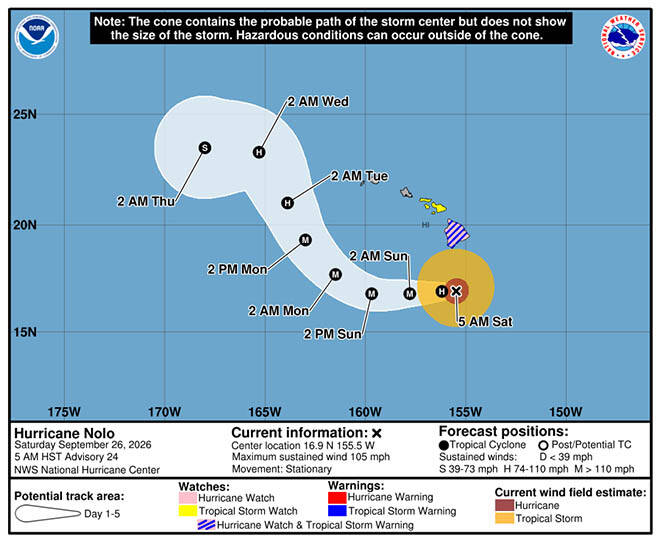
The agency sounded an outdoor warning siren on Niihau on the evening of Sept. 7 as hurricane-force winds moved toward the island. The siren warned residents to stay indoors ahead of the imminent arrival of sustained winds of 74 mph or greater.
Lowell knocked out power to most of Kauai and battered its north and south shores with flooding and storm surge. The Kauai police said there were two deaths during the storm. Eighteen homes were destroyed and 67 suffered major damage.
But there were no injuries on Niihau and everyone was accounted for, Ushio said.
“They told us about 30 were there for the storm,” he said.
No other details have been available.
“We, as well as the Robinsons, have been getting so much media questions,” Ushio said. “And they really try to be protective of their community.”
Members of the Robinson family didn’t return calls seeking comment.
Ushio said he had built a relationship with the Robinsons over his 33 years of working for the county. He has been to Niihau twice. In the 1980s, his father, a state Education Department employee, would jump on a barge taking supplies to Niihau every so often to check on the island’s school.
“They operate on a lot of old-school trust,” Ushio said. “In Hawaii, a lot of things is by trust.”
Whenever a storm threatens the county, the Robinsons, who also have significant land holdings on Kauai, participate in daily coordination calls, which include National Weather Service officials, utility leaders and the Federal Emergency Management Agency, Ushio said.
The Robinsons and the other residents of Niihau “are the toughest, most \extraordinary people you’re ever going to meet,” Green said. “They felt that they probably didn’t need any federal assistance because they are so resilient. They are used to living for generations independently.”
The Robinson brothers, who are in their 80s, are not Hawaiian but grew up fluent in the Niihau dialect of Hawaiian that is spoken on the island.
“The Robinsons are not considered outsiders,” said Hinaleimoana Wong, a Hawaiian cultural practitioner who lives in Honolulu. She is fluent in Niihau Hawaiian because she was taken in as a youth by a Niihau family, she said.
“They are not looked at by the Niihauans as the marauders, the plunderers, the raiders or the oppressive ones,” she said.
Niihau is an island of deep faith, she said. Missionaries introduced the Protestant branch of Christianity to Hawaii in the 19th century. On Niihau, they follow “kalawina,” or Calvinist theology, Wong said.
“When they received word that the storm is going to hit, they’re praying, they’re in church,” she said. “You have a Pacific island whose faith is greater than any storm.”
There are strict rules against tobacco and alcohol on Niihau, she said.
Hawaiian culture has remained far more intact on the island than in other parts of Hawaii that were transformed by U.S. colonization and the 1893 overthrow of the Hawaiian kingdom by a group of American businessmen.
“The Native Hawaiian community is always protesting, rallying, marching,” Wong said. “We got lots to grumble about because we suffered great degradation and loss of language, culture and history. But they didn’t.”
© 2026 The New York Times Company